


Medically reviewed by Jackie Giannelli, FNP-BC, MSCP
Exercise snacks are one-minute bursts of movement you scatter through the day: a fast flight of stairs, ten squats while the kettle boils, a walking call. In perimenopause, they do more than fill a step count. They help counteract the hours you spend sitting, and in turn, support blood sugar management and your heart.
Here’s how you can get more exercise snacks into your day.
Want to set up your home to support your health from every possible angle? Grab my free Healthy Home Protocols checklist, which walks you through your whole house, one change at a time. Get the checklist here.
What are exercise snacks, and do they actually work?
Exercise snacks are short bursts of activity, usually a minute or less and often hard enough to make you breathe heavily, done a few times across the day. They work because frequency matters, and because the minutes add up even when no single bout looks like a workout. You do not have to change clothes, drive anywhere, or block out an hour.
The research backs them up. A McMaster University study had sedentary young adults sprint up a three-flight stairwell (60 steps) three times a day, three days a week, for six weeks. Compared with a group that didn’t train, the stair climbers finished with higher aerobic fitness. (1)
Official guidance moved the same way quite some time ago. The 2018 Physical Activity Guidelines for Americans dropped the old rule that activity had to come in bouts of at least ten minutes to count. So any amount of moderate-to-vigorous movement now counts toward your weekly total. (2)
I think that change deserved more attention than it got. So many of us have been conditioned to believe that any day without a 45-minute fitness class “doesn’t count” and that’s just holding us back from optimal wellness.
Do exercise snacks work for women over 40?
Exercise snacks look especially useful for women over 40, and the strongest data we have is about your heart. In a 2024 study in the British Journal of Sports Medicine, researchers at the University of Sydney gave activity trackers to more than 22,000 adults aged 40 to 79 who did no structured exercise at all, then followed their heart health for years. (3)
The 13,018 women who averaged just 3.4 minutes a day of short, vigorous bursts (climbing stairs, carrying heavy shopping, walking fast uphill) had a 45% lower risk of major cardiovascular events than women who did none. Their risk of heart failure was 67% lower.
Even 1.2 to 1.6 minutes a day was linked to a 30% lower risk. (3) Just over a minute per day!
Now, there are two caveats to this research. This was an observational study, so it shows a link, not proof that the bursts caused the benefit. And the men in the same study saw a much smaller effect.
But here’s why I still pay attention to it as a menopause clinician. Your heart risk climbs after menopause as estrogen’s protective effect on your blood vessels fades. Your body also starts handling blood sugar differently and storing more fat around your middle. So the real question is whether three minutes of stairs a day is worth it for the next thirty years of benefit for your heart. I’d say yes.
Why moving after meals matters more in perimenopause
Moving for a few minutes after you eat is one of the most useful exercise snacks there is, because it blunts the blood sugar spike that follows a meal. Your muscles pull sugar out of your blood when they work, without needing as much insulin to do it.
A small 2016 trial in Diabetes Care showed how little movement it actually takes. Twenty-four inactive adults with type 2 diabetes sat for eight hours on three separate days. On two of those days, they got up every 30 minutes for three minutes of either easy walking or simple moves like half-squats and calf raises. Both kinds of exercise breaks cut the rise in blood sugar after meals by about 39% compared with sitting. (4)
A 2022 review in Sports Medicine pooled seven studies like this one and found that walking lowered both blood sugar and insulin after meals. Standing breaks helped blood sugar a little, but walking did more. (5)
Why does this matter if you don’t have diabetes? Because insulin resistance tends to creep up through perimenopause, and the afternoon after a big lunch is often where you feel it first. A ten-minute walk after lunch, or three minutes of squats and calf raises in the kitchen, is the cheapest lever I know of to help combat this.
If your energy falls off a cliff around 3 pm, I wrote about the other reasons that happens in: why low estrogen can leave you tired.
How to build exercise snacks into your house (no home gym required)
The way to build exercise snacks into your life is to attach each one to something your house already makes you do. You stop relying on willpower and start relying on the stairs, and external cues like waiting for the coffee maker to brew.
That’s the whole idea behind the Sweat pillar in my 6S framework for a healthy home: frequency beats intensity. And removing friction so you can frequently get in little bouts of exercise is the real win.
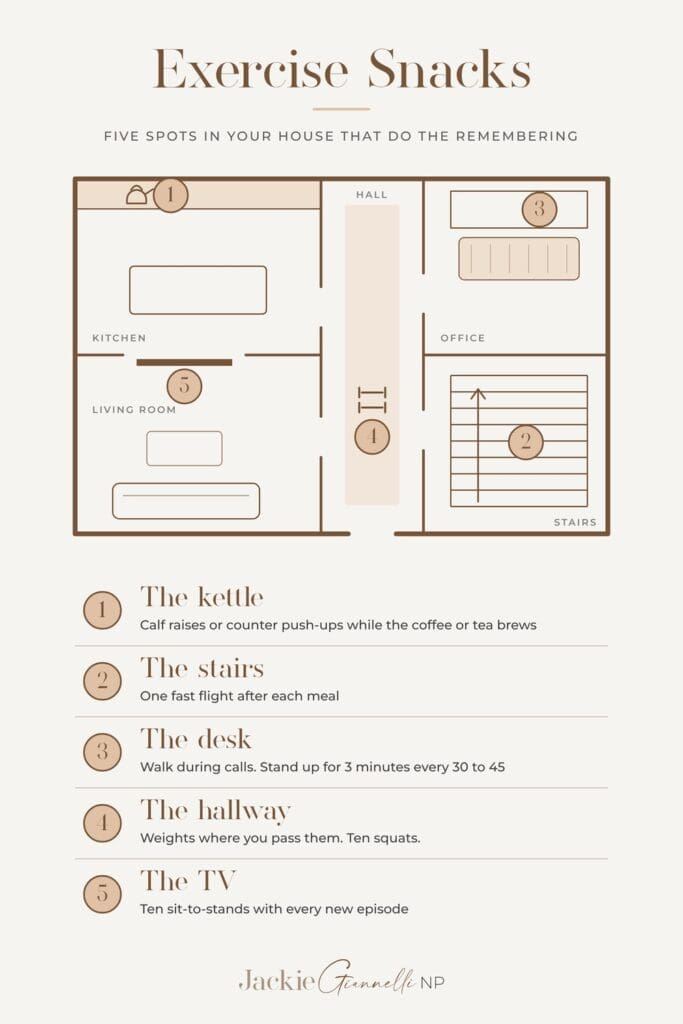
If you’ve been looking for a home workout for women over 50 that you’ll keep doing, this is the version I’d start with. Pick two or three of these below, and start doing them daily. You’ll be surprised at how much you can sneak in during the day.
The kettle or the coffee maker
Every time something is brewing, you have two to four minutes. Do calf raises at the counter, or push-ups with your hands on the counter edge. You can go slowly or quickly, and mix it up if you want.
The stairs
If you have stairs, take one flight, fast, after each meal. Fast enough that you’re breathing harder at the top. That’s the same move the McMaster stair study used, and it’s the kind of burst the University of Sydney trackers counted. (1, 3)
The desk and the phone
Make every phone call a walking call, around the house or on a walking pad.
If you work at a computer, set a timer for every 30 to 45 minutes and get up and at least walk around for three minutes when it goes off. Doing some air squats is even better.
The hallway or the bedroom door
Keep a pair of dumbbells or a kettlebell where you’ll walk past it, not in a closet. When you see it, do ten squats holding it or ten rows. Equipment that is out of sight doesn’t get used.
The TV
Do ten sit-to-stands from the couch at each commercial break, or every time you start a new episode. Stand all the way up, sit all the way down, without using your hands if you can.
A simple first week of movement snacks
You don’t need a plan with a spreadsheet to do this. Just start.
- Pick your three cues. One after a meal, one tied to a chore you already do (the kettle, the dishwasher), and one tied to a screen (calls or TV).
- Pick one move for each. A fast flight of stairs, ten calf raises, ten sit-to-stands. Keep each one under two minutes.
- Set it up tonight. Put the dumbbells by the door, write “stairs” on a sticky note by the coffee maker. Make the cue impossible to miss.
- Check in on day seven. Which cue did you answer most days? Keep that one, swap the one you skipped, and add a fourth only if three felt easy.
Movement snacks work because they are small enough to repeat. If one feels like a chore, make it smaller before you give it up.
Are walking pad benefits real, or just a trend?
Walking pad benefits are real, but they’re modest, and they shrink considerably if the pad ends up under the bed.
The best long-term evidence comes from treadmill desks. In a 2013 study in Obesity, 36 office workers (25 of them women) had their regular desks swapped for treadmill desks for a full year. At six months they were sitting about 91 fewer minutes a day. At twelve months it was about 42 fewer minutes. So the effect faded but did not disappear. They lost an average of about 1.4 kg (3 pounds), and their work performance held steady. (6)
So my take is this. A walking pad is worth buying if it lives where you already work or take calls. You have to set it up so using it takes zero effort. It’s not worth it if you have to drag it out every time. Your walking pace while you type is also gentle, so it’s not really a substitute for the short, harder bursts that get your heart rate up.
The best case scenario is using a walking pad to break up sitting time, plus a few real exercise snacks on top.
How to keep moving as the days get shorter
The clocks fall back on November 1, 2026, and that’s usually when your daily movement drops without you ever deciding it should. The evening walk becomes a walk in the dark, and then it stops happening.
Build your snacks into the indoor parts of your day now, before that happens. Then move one of them outside in the morning, a ten-minute walk in daylight, because morning light helps your sleep and mood as the season turns. I covered that side of fall in what shorter days do to your nervous system.
One more thing. Exercise snacks are the floor. They don’t replace lifting something heavy two or three times a week, which is what your muscle and bone need in midlife. That’s a post for another day.
Frequently asked questions
An exercise snack can be as short as 20 seconds to a minute if it’s vigorous, like a fast flight of stairs. Gentler snacks, like walking or calf raises after a meal, work well at two to ten minutes.
Aim for three to five a day. In the University of Sydney study, women who averaged about 3.4 minutes a day of short, vigorous bursts had the lowest heart risk, and even 1.2 to 1.6 minutes a day was linked to a benefit. (3)
Yes. Since 2018, the Physical Activity Guidelines for Americans count any amount of moderate-to-vigorous activity toward the weekly 150 minutes, with no minimum bout length. (2)
The short answer is yes, for blood sugar and sitting time. Outside walking adds daylight, uneven ground, and usually a faster pace, so if you can do one of your walks outdoors, do.
No. Exercise snacks are a great base, but muscle and bone in midlife need heavier, deliberate strength work two or three times a week. Use snacks to cut your sitting time and lift on top of them.
Usually, yes, and they’re an easier on-ramp than a full workout. Start with the gentle versions. If you have a heart condition, get chest pain, dizziness, or unusual shortness of breath, or haven’t been active in a long time, talk to your clinician before you add vigorous bursts of activity.
Grab the checklist
Pick two exercise snacks from this post and tie them to the kettle and the stairs this week. Be sure to let me know how it goes.
If you want to keep going room by room, my free Healthy Home Protocols checklist covers the rest of the house too: air, water, kitchen, bedroom, and the small swaps that matter most in midlife.
Get the Healthy Home Protocols checklist
This content is for informational and educational purposes only and is not intended as medical advice. Talk to your healthcare provider before starting a new exercise routine.
References
- Jenkins EM, Nairn LN, Skelly LE, Little JP, Gibala MJ. Do stair climbing exercise “snacks” improve cardiorespiratory fitness? Applied Physiology, Nutrition, and Metabolism. 2019;44(6):681-684. https://doi.org/10.1139/apnm-2018-0675
- U.S. Department of Health and Human Services. Top 10 Things to Know About the Second Edition of the Physical Activity Guidelines for Americans. 2018. https://odphp.health.gov/our-work/physical-activity/current-guidelines/top-10-things-know
- Stamatakis E, et al. Device-measured vigorous intermittent lifestyle physical activity (VILPA) and major adverse cardiovascular events: evidence of sex differences. British Journal of Sports Medicine. 2024. https://doi.org/10.1136/bjsports-2024-108484
- Dempsey PC, Larsen RN, Sethi P, et al. Benefits for type 2 diabetes of interrupting prolonged sitting with brief bouts of light walking or simple resistance activities. Diabetes Care. 2016;39(6):964-972. https://pubmed.ncbi.nlm.nih.gov/27208318/
- Buffey AJ, Herring MP, Langley CK, Donnelly AE, Carson BP. The acute effects of interrupting prolonged sitting time in adults with standing and light-intensity walking on biomarkers of cardiometabolic health in adults: a systematic review and meta-analysis. Sports Medicine. 2022;52(8):1765-1787. https://doi.org/10.1007/s40279-022-01649-4
- Koepp GA, Manohar CU, McCrady-Spitzer SK, et al. Treadmill desks: a 1-year prospective trial. Obesity. 2013;21(4):705-711. https://doi.org/10.1002/oby.20121


