


Medically reviewed by Jackie Giannelli, FNP-BC, MSCP
Healthspan vs. lifespan is the difference between how long you live and how long you live well. Lifespan counts birthdays. Healthspan counts the years you can still carry your own groceries, sleep through the night, and remember why you walked into the room.
But here’s the best news: in your 40s and early 50s, you can do a lot to affect your healthspan later in life.
Let’s dive into the specifics.
The ultimate first step: start tracking your numbers. Download my free unBridled Longevity Blueprint™ Lab Guide to get the list of markers I want to see on every woman over 35. Get the Lab Guide here.
Healthspan vs. lifespan: what’s the difference?
The difference between healthspan and lifespan is quality versus quantity. Lifespan is the total number of years you live. Healthspan is the stretch of those years you spend in good health, before chronic disease, pain, or frailty start running your days.
Here’s what that gap looks like in real life. In the U.S., you can expect to spend about 12 of your final years living with a chronic illness or disability. That’s the longest stretch of any country studied, according to a 2024 analysis of 183 nations in JAMA Network Open. (1)
That’s 12 years of appointments, prescriptions, and “I can’t do that anymore.”
I’d rather you spend them living.
Healthspan vs. lifespan at a glance
| Lifespan | Healthspan | |
|---|---|---|
| What it counts | Every year you’re alive | The years you’re healthy and functioning on your own terms |
| What extends it | Treatment that keeps you alive longer once you’re sick | Prevention, daily habits, and catching risk early |
| How you’d notice it | A birthday | Carrying your own suitcase, sleeping through the night, wanting sex, remembering your neighbor’s name |
| U.S. average for women | 81.4 years (2) | About 12 years shorter than lifespan (1) |
Why do women live longer but spend more years in poor health?
Healthspan vs. lifespan looks different for women. You’re likely to live longer than the men in your life, and more of those extra years are spent unwell.
According to the CDC’s National Center for Health Statistics, life expectancy at birth in 2024 was 81.4 years for women and 76.5 years for men. (2)
However, the 2024 JAMA Network Open analysis found that women’s healthspan gap was 2.4 years wider than men’s worldwide, and 2.6 years wider in the United States. (1)
Researchers named musculoskeletal, genitourinary, and neurological disease as the biggest contributors to this difference in women. (1)
In other words, it’s the knee that stopped letting you run, the bladder that decides when you leave the house, and the word you can’t find mid-sentence.
But the good news is that almost everything on that list has something you can do about it in your 40s and early 50s.
Does menopause affect your healthspan?
Some of the numbers that shape your later decades change during the menopause transition, faster than age alone might explain.
That means your 40s and early 50s are a critical window that can affect the healthspan vs. lifespan gap you’ll live with at age 75.
The clearest example is cholesterol. The Study of Women’s Health Across the Nation, a long-running American project that has followed thousands of women through menopause, tracked 1,054 women through their final period. Total cholesterol, LDL cholesterol, and apolipoprotein B (ApoB, a measure of the particles that build plaque in your arteries) jumped in the year before and after the final period. Most other heart risk factors rose in a straight line with age. (4)
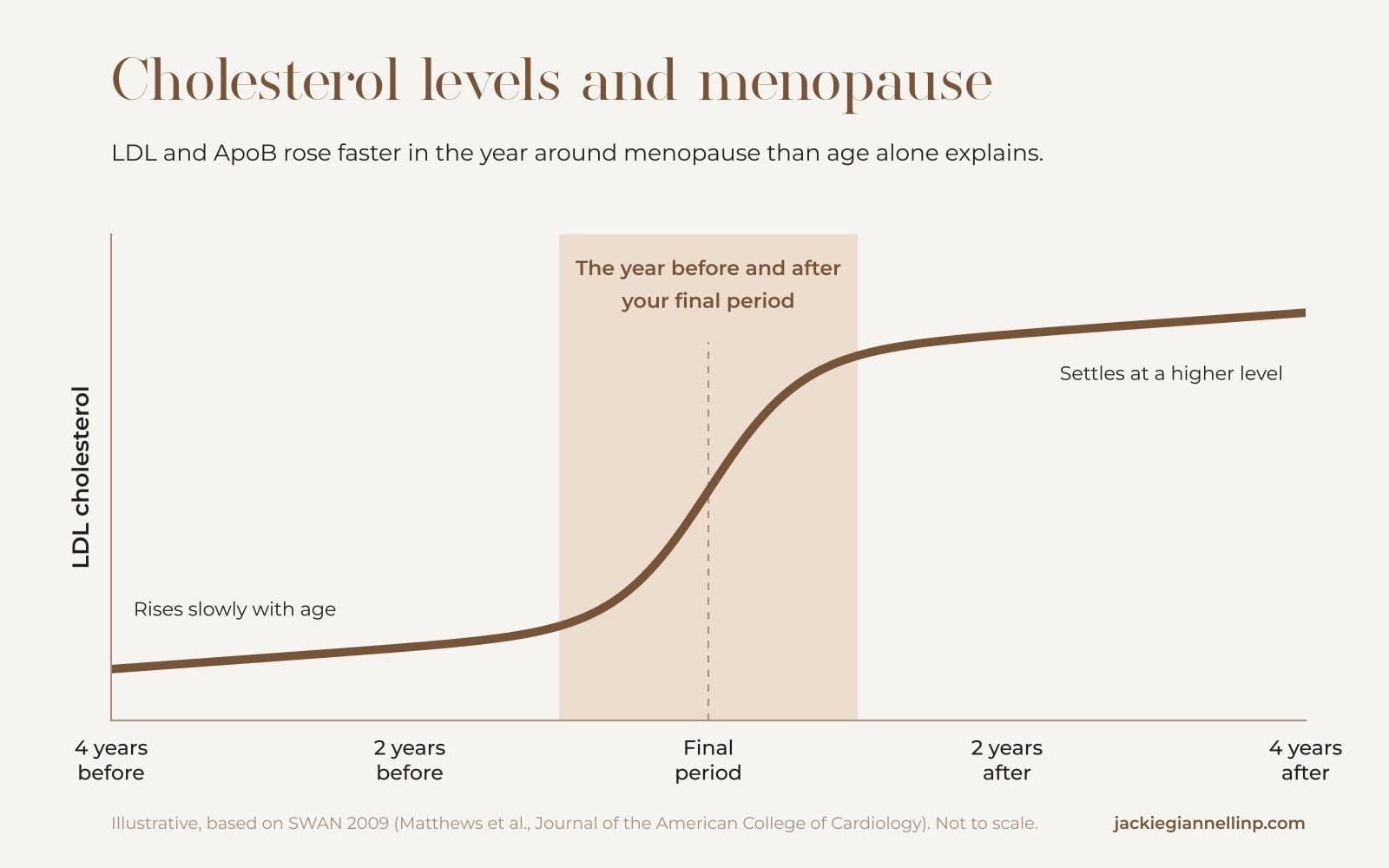
So your cholesterol can look fine at 46 and look different at 51, with nothing about your diet or habits changed. Heart disease is still the leading cause of death in women, and it usually builds for years before it causes a single symptom. Muscle and bone loss also speed up in these same years.
Is your sex life part of your healthspan?
Yes, and it’s the part of healthspan I personally specialize in. I call it your sexspan: the years you still want sex, enjoy it, and feel at home in your body. In my practice, it belongs on the healthspan list right next to strength and sleep.
The PRESIDE study surveyed 31,581 American women in 2008 and found that 43.1 percent reported some kind of sexual problem. Problems that caused real distress peaked between ages 45 and 64, at 14.8 percent. (5) So midlife is when this issue shows up most, but it’s also when a lot of other symptoms start cropping up, and we often feel awkward bringing it up with a provider.
Desire usually changes in midlife for more than one reason. For one, estrogen and testosterone both shift. On top of that, poor sleep and a heavy mental load drain the energy desire runs on. And some medications, including certain antidepressants and birth control, can lower libido.
And your relationship and context matter too. I work through all of these with a patient, because fixing one rarely fixes the whole picture.
Pain with sex and vaginal dryness are a separate problem with a separate fix. They’re part of the genitourinary syndrome of menopause, and they usually respond to local vaginal estrogen, which can be used with or without systemic hormone therapy. If sex has started to hurt, book the appointment, ideally with a clinician trained in sexual medicine.
Wanting sex at 78 is a healthspan goal like any other. Bring it up at your next annual the same way you’d bring up your joint pain.
Live in New York, Massachusetts, or Connecticut and want to work with a provider who will ask you these questions first? Click here to book an assessment with me.
What is longevity, really?
Longevity, the way I use the word, means the next 30 years of function. It’s being able to do the things you care about, on your own terms, for as long as you’re here.
Picture yourself at 78. You get up off the floor without a hand on the couch. You lift your own bag into the overhead bin. You read the menu, remember the acquaintance’s name at dinner, sleep through the night and still want sex. You say yes to the trip.
That’s what longevity is about.
And when it comes to longevity, your genes matter less than you’d think. A 2018 study in Genetics used family trees to compare how long relatives lived. It found that husbands and wives had lifespans that matched more closely than siblings did. That suggests much of what runs in families is the way they live.
The researchers estimated that genes explain less than 10 percent of how long you live. (3) How long your grandmother lived is a data point. But how you live the next decade counts for more.
Should you focus on healthspan or lifespan?
Focus on healthspan. That’s because lifespan is a number that only reveals itself at the end. Healthspan shows up every morning, in your knees on the stairs and in whether you can keep up with the people you love.
And here’s the thing. Healthspan habits are the habits that tend to add years to your lifespan too, so you aren’t trading one for the other.
There’s a family dynamic to this that I think about a lot. The years spent unwell at the end of life are rarely spent alone. Usually, someone drives to the appointments, sorts the pills, and moves into the guest room.
I personally don’t want to ever be a burden on my children or anyone else. I want to be independent, able to go where I please, and do what I want. I’m pretty sure you feel the same way.
How do you increase your healthspan in your 40s and 50s?
You increase your healthspan in midlife by knowing your numbers, keeping your muscle, protecting your sleep, and making hormone treatment decisions with intention.
Here’s the short list:
- Get a baseline you can compare against. A lipid panel that includes ApoB, an A1C, your blood pressure, and a few hormone markers gives you a starting line.
- Lift something heavy, and move in between. Strength training twice a week is the closest thing to a healthspan prescription I have. On the days you can’t train, short bursts count too, and exercise snacks you can build into your house are a great fill-in for anyone of any age.
- Protect your sleep. Sleep that holds through the night protects your mood, your blood sugar, and your memory. If night sweats or 3 a.m. wake-ups are breaking it up, bring that to your clinician, because it’s treatable.
- Have the hormone therapy conversation. Hormone therapy isn’t right for everyone, and it’s a decision to make with a clinician who knows the current evidence. Timing matters for this one. I don’t want you to drift past the ideal window without having the conversation at all.
- Set up your house so the healthy choice is the easy one. Your home shapes your health every day, whether you’re paying attention or not: how dark your bedroom gets, what you’re breathing, what’s within reach when you’re hungry at 4 p.m. That’s the idea behind my 6S framework for a healthy home. You make the change once, and it keeps working without you.
Want the markers I’d put on your baseline? My free unBridled Longevity Blueprint™ Lab Guide lists the labs I want on every woman over 35, what each one tells you, and the ranges where I start paying attention.
Is longevity medicine the same as biohacking?
Longevity medicine, done well, is prevention with better measurement. It means tracking the markers that predict how your later decades go and acting on them early.
Biohacking, on the other hand, is the gadget-and-protocol culture around it, and it tends to sell you more tests and more supplements. For too long, this space has been dominated by a bunch of men with no medical credentials and a loose interpretation of the word science.
I’ll be honest with you: the longevity space is the wild, WILD west right now. Before you spend a dime on anything a “biohacker” recommends, splash out for a strength coach or a more comprehensive blood draw than your insurance will cover.
That’s the kind of thinking I wove into my Longevity Lab: your labs and your history, read together, so your plan comes from your own data instead of someone else’s protocol. Get on the waitlist here.
Frequently asked questions
Healthspan is the number of years you live in good health, free of the chronic disease, pain, or disability that limit what you can do. It’s a smaller number than lifespan, and the difference between the two is called the healthspan gap.
For most of the women I see, yes. More years only feel like a gift if you can use them. The habits that extend healthspan, like strength training, good sleep, and catching heart risk early, also tend to support a longer life.
The healthspan gap is the number of years a person lives with significant illness or disability at the end of life. A 2024 analysis of 183 countries in <em>JAMA Network Open</em> found it averaged 9.6 years worldwide in 2019 and 12.4 years in the United States, the widest of any country. (1)
Yes. Strength training builds muscle at 65 and 75, and blood pressure and cholesterol respond to treatment whenever you start. Starting in your 40s gives you more runway, but starting at 60 still counts.
Low desire is common in midlife, and it’s treatable. It usually has more than one cause, from hormones and sleep to medications and stress, so it’s worth a full conversation with a clinician who works in sexual medicine.
Less than family stories suggest. A 2018 study in <em>Genetics</em> concluded that the true heritability of human lifespan was well below 10 percent, once the researchers accounted for spouses tending to share habits and environment. (3) Your daily choices carry far more weight than your family tree.
Lifespan is how long one person actually lives. Life expectancy is a population average, the number of years a group of people born in a given year would be expected to live. In the U.S. in 2024, it was 81.4 years for women. (2)
Where to start with your healthspan this week
Start with a baseline. Book the blood work, write down your blood pressure, and put two strength sessions on next week’s calendar. That’s healthspan vs. lifespan in practice: small, repeatable choices now, so the 78-year-old version of you gets more good years.
If you want the list of markers to ask for, and the ranges where I start paying attention, my free Lab Guide has all of them.
Get the free unBridled Longevity Blueprint™ Lab Guide
This content is for informational and educational purposes only and is not intended as medical advice. Talk to your healthcare provider before making changes to your care.
References
- Garmany A, Terzic A. Global healthspan-lifespan gaps among 183 World Health Organization member states. JAMA Network Open. 2024;7(12):e2450241. https://doi.org/10.1001/jamanetworkopen.2024.50241
- National Center for Health Statistics. Life Expectancy (FastStats), from Mortality in the United States, 2024. Centers for Disease Control and Prevention. https://www.cdc.gov/nchs/fastats/life-expectancy.htm (data brief: https://www.cdc.gov/nchs/products/databriefs/db548.htm)
- Ruby JG, Wright KM, Rand KA, et al. Estimates of the heritability of human longevity are substantially inflated due to assortative mating. Genetics. 2018;210(3):1109-1124. https://doi.org/10.1534/genetics.118.301613
- Matthews KA, Crawford SL, Chae CU, et al. Are changes in cardiovascular disease risk factors in midlife women due to chronological aging or to the menopausal transition? Journal of the American College of Cardiology. 2009;54(25):2366-2373. https://doi.org/10.1016/j.jacc.2009.10.009
- Shifren JL, Monz BU, Russo PA, Segreti A, Johannes CB. Sexual problems and distress in United States women: prevalence and correlates. Obstetrics & Gynecology. 2008;112(5):970-978. https://pubmed.ncbi.nlm.nih.gov/18978095/


