


Medically reviewed by Jackie Giannelli, FNP-BC, MSCP
How to check hormones is easier than it sounds. You can order the panel yourself in most states and have the draw done this week. The question then becomes what to do with that information. And here’s the really tricky part. One single draw doesn’t always tell you what you want to know…which is typically the answer to the question, “Why am I still waking up at 3 AM every morning?” or “Why do I keep gaining weight when I haven’t so much as looked at a carbohydrate in 6 months?”
I am a nurse. And nurses tend to empower patients. We tend to educate and encourage rather than gatekeep.
So that’s what I’m going to do in this article. Help you actually check your hormones and then figure out what to do with the readings you get.
First step: download my Lab Guide built exactly for this moment: a free PDF of the lab markers that matter most for women 35 and up, decoded in plain language, so you can get what you need. Grab it here.
How to check hormones
Checking hormones is a venous blood draw, timed to your cycle if you still have one, ordered either by your clinician or by you directly through a lab service.
Here’s the short list:
- Ferritin
- A full thyroid panel
- B12
- Vitamin D
- A1c
- Estradiol
- FSH
For the full, comprehensive list, be sure to download my Lab Guide here.
Why one blood draw isn’t the full picture
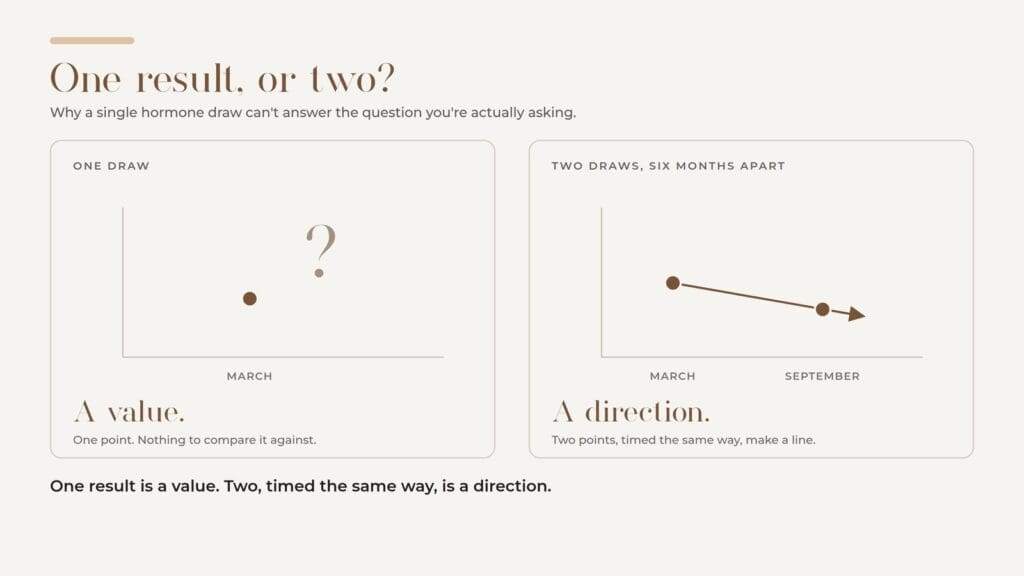
One hormone value tells you where a number sat on one particular morning.
The real question living underneath almost all testing is a different one: is this changing, and in which direction? A single draw simply cannot answer that.
The Study of Women’s Health Across the Nation (SWAN), a long-running American research project that has followed thousands of women through the menopause transition, mapped what estradiol actually does across the menopausal years. It found four separate patterns.
About 31.5% of women showed a rise beginning roughly five and a half years before the final period, then a steep fall in the last year. Another 13.1% rose and then declined slowly. About 26.9% declined slowly with no rise at all, and 28.6% stayed relatively flat throughout. (2) FSH split three ways in the same women: 40.7% rose high, 48.7% medium, and 10.6% low. (2)
A second snapshot helps you understand where your hormone story fits into one of these categories.
When is the best time to test for hormone imbalance, and why once is not enough
The best time to test is whenever you can time the draw to your cycle, and then again on the same relative day a few months later.
Yes, I’m suggesting you take another draw a few months later.
The second draw is the one that turns a number into information.
Here is what a trend hands you that a single value cannot:
- Direction. Rising, falling, or holding. This is what you really need to know.
- Rate. Whether you are moving slowly or fast, which changes how urgent any of it is.
- Confirmation, or the lack of it. Whether the change you have been feeling in your body shows up in the data at all. Both answers are useful.
- Response. Whether something you changed, like iron intake, training load, sleep, a medication, moved anything measurable.
- A starting line. A number to measure the next one against.
The goal is to shoot for the same relative day of your cycle, and the same lab if you can manage it. Assays can vary between labs, so two values from two different companies are harder to compare than two from the same one. If your cycles have gone irregular, pick a date and go with it.
Why setting a baseline matters
A baseline is a gift you send forward to yourself. An ApoB or a ferritin drawn at 44 costs nothing extra today, and it becomes the reference point you cannot buy back at 52. Without the earlier number, “is this new?” has no answer at precisely the moment the question starts to matter.
The SWAN study I mentioned earlier documented sharp increases in total cholesterol, LDL cholesterol, and apolipoprotein B within a one-year window surrounding the final menstrual period. The same research reported that the rate of fat gain roughly doubled about two years before that point, while lean mass began to decline. (2)
If the ApoB you see at 52 is the first one you have ever had, it is a number with no history attached, and a number with no history is genuinely hard to act on. If it is your third, you know whether it moved, how far, and how fast, and so does whoever is reading it with you. This is the strongest argument I know for learning how to check hormones in your early forties, before peri gets loud.
What changes when the data is yours
Here’s what’s really happening when you take charge of your health. The questions you ask get sharper. And you become more difficult to dismiss. “What is wrong with me?” is an open-ended question, and open-ended questions get open-ended answers. “Here is what I have tracked since February, what do you make of it?” is a question that comes from a place of power, and questions like those get answered.
Three things shift when you walk into appointments like this.
- You are no longer reconstructing your own history out loud from memory, because it exists as a document.
- You are no longer the only source of information in the room, because your dates and numbers are talking too.
- And you are no longer in the position of having to persuade anybody, because a trend is not an argument. It is a set of results with dates on them.
And yes, I am aware that you shouldn’t have to arm yourself to go into a doctor’s appointment. But that is the current state of affairs for almost all the women I talk to.
How does a doctor check hormone levels, and what can you decide yourself?
A clinician checks hormone levels the same way you would: a venous blood draw sent to a lab, read alongside your history.
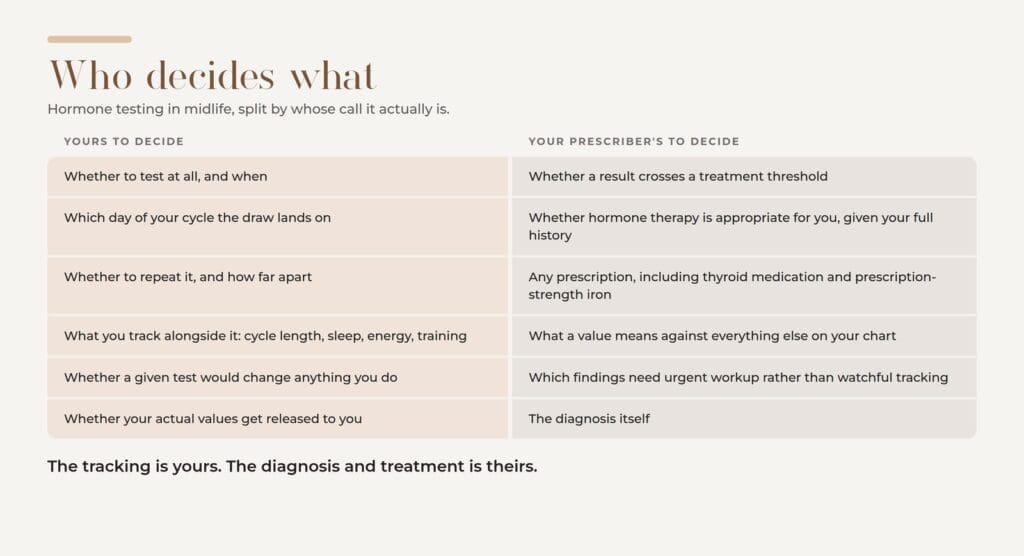
In other words, it’s a division of labor. The tracking is yours. The diagnosis and treatment is theirs.
You know what else sits squarely in your hands? Your habits. Iron intake, sleep, resistance training, and how much alcohol you drink in a given week all live in the left-hand column, and they can support the markers they touch.
What are normal hormone levels in a woman?
There is no single set of numbers that answers this. A reference range is a population statistic built from a spread of people, and a range is not necessarily a target. The reference range that will tell you the most about your own body is your own previous value. That’s what I want you to build here.
What’s remarkable here is that the medical community agrees, for the most part, that hormone testing for peri/menopause should be a secondary “nice to have” rather than a basis for treatment. Your symptoms are what really matter at the end of the day. (1,3) Sexual dysfunction, fatigue, hot flashes, all of it…those symptoms and tracking them belong to you.
How to check hormones so you never start from zero again
Here’s the real problem: ordering bloodwork once is something simple a provider can do within the 15-minute window they’ve been given to treat you. That’s why it’s all you get.
And this is why you have to proactively drive your whole midlife experience.
Combining a detailed symptom tracking log from your wearable device, app, or a plain written notebook combined with a set of blood draws showing a pattern is an unstoppable combination for getting to the bottom of why you’re not feeling like yourself. This is the data that helps your provider actually build a treatment plan, quickly.
This article is for informational and educational purposes only and is not medical advice, diagnosis, or treatment. Talk with your own licensed clinician about testing and treatment decisions. This post contains affiliate links, which means I may earn a small commission if you buy through them, at no extra cost to you.
Your next step: download my Lab Guide built exactly for this moment: a free PDF of the lab markers that matter most for women 35 and up, decoded in plain language, so you can get what you need. Grab it here.
Questions women ask me about how to check hormones
A venous blood draw is the standard, ordered either by your clinician or by you through a direct-to-consumer lab service. Which markers to request and when to draw them is covered in full in <a href=”https://jackiegiannellinp.com/can-low-estrogen-cause-fatigue/”>Can Low Estrogen Cause Fatigue? Plus, Why Labs Can Miss It</a>, under “The labs I would actually want, and how I would read them.” The part worth planning for now is the second draw, because that is where a number becomes a direction.
Often enough to see movement, which for most reproductive-hormone questions means a repeat draw a few months after the first, on the same relative day of your cycle. Cardiometabolic markers like ApoB and A1C are usually tracked on a longer interval. The number of draws matters less than whether they are comparable to each other, so keep the day, the lab, and the date consistent.
At-home kits use a finger-prick blood spot, saliva, or <a href=”https://mira-fertility.pxf.io/BnQ6DJ” rel=”sponsored nofollow noopener” target=”_blank”>urine</a>, and they are a convenient option for repeat tracking of a marker you already know matters to you. They are weaker where assay precision drives a decision. The Global Consensus Position Statement on the Use of Testosterone Therapy for Women found that “direct assays for the measurement of total and free testosterone are highly unreliable in the female range.” (3) If a result will drive a prescription, ask for a venous draw.
Track two things in parallel rather than one. Your own record (cycle length, sleep, energy, mood, recovery, with dates) is one line, and timed labs are the other. A change that shows up in both is far more informative than either on its own, and neither one is interpretable from a single day.
Not on its own, if you are over 45. The European Society of Endocrinology’s 2025 clinical practice guideline states that biochemical testing “is not necessary” for diagnosing perimenopause in women older than 45, because at that age it is a clinical diagnosis made from your cycle pattern and symptoms. (1) Under 40 the picture changes: that guideline confirms premature ovarian insufficiency with one FSH above 25 IU/L, or two measurements more than four weeks apart. (1)
Coverage depends on your plan, your diagnosis codes, and whether the test was ordered by a clinician or bought directly. Cash pricing through a direct-to-consumer lab is sometimes lower than an insured visit against an unmet deductible, which is worth checking before you assume either way. There are also places online that will allow you to order your own labs.
The tracking logic holds, and the specific markers differ. The 2023 International Evidence-based Guideline, led by Helena Teede and colleagues, states that anti-Mullerian hormone “could be used for defining PCOM in adults” but that “serum AMH should not be used as a single test for the diagnosis.” (5) It also states that clinically available insulin assays “are of limited clinical relevance and are not recommended in routine care,” so an oral glucose tolerance test or A1C plus a lipid panel does more for you metabolically. (5) PMOS is the new name for what was called PCOS until May 2026. (4)
File them with the date, note which day of your cycle the draw happened on, and decide the repeat interval while the first result is still fresh. Then write down what you would want the second number to tell you. Deciding in advance what would change your actions is what stops testing from becoming a collection.
References
- Lumsden MA, et al. European Society of Endocrinology clinical practice guideline for evaluation and management of menopause and the perimenopause. European Journal of Endocrinology. 2025;193(4):G49-G81. Recommendations 1.4 and 1.5. https://academic.oup.com/ejendo/article/193/4/G49/8281862
- El Khoudary SR, et al. The menopause transition and women’s health at midlife: a progress report from the Study of Women’s Health Across the Nation (SWAN). Menopause. 2019;26(10):1213-1227. https://pmc.ncbi.nlm.nih.gov/articles/PMC6784846/
- Davis SR, et al. Global Consensus Position Statement on the Use of Testosterone Therapy for Women. Journal of Clinical Endocrinology and Metabolism. 2019;104(10):4660-4666. https://academic.oup.com/jcem/article/104/10/4660/5556103
- Endocrine Society. Polyendocrine Metabolic Ovarian Syndrome: New name to improve diagnosis and care of condition affecting 170 million women worldwide. May 12, 2026. Consensus published same day in The Lancet. https://www.endocrine.org/news-and-advocacy/news-room/2026/pcos-name-change
- Teede HJ, et al. Recommendations from the 2023 International Evidence-based Guideline for the Assessment and Management of Polycystic Ovary Syndrome. Human Reproduction. 2023;38(9):1655-1679. Recommendations 1.5.1, 1.5.3, and 1.9.12. https://academic.oup.com/humrep/article/38/9/1655/7241786


