


Medically reviewed by Jackie Giannelli, FNP-BC, MSCP
Here’s the question I’d ask about your workouts in midlife: are they heavy enough to hold on to your muscle and bone? If your week is walks, Pilates, and a pair of 5-pound dumbbells, probably not yet. Let’s look at how sarcopenia and exercise are related. Plus, how to build a workout that works.
Muscle is one half of the picture. The other half is in your blood work, and my free unBridled Longevity Blueprint™ Lab Guide lists the markers I check on every woman over 35. Get the Lab Guide here
What is sarcopenia?
Sarcopenia is the gradual loss of muscle strength and muscle mass that comes with age, to the point where it starts to limit what you can do.
The European Working Group on Sarcopenia in Older People rewrote its definition in 2019 to put strength first, ahead of how much muscle shows up on a scan. (1)
In other words, what’s most important is what you can do, not the amount of muscle mass you can see.
And this matters in peri/menopause because muscle loss starts surprisingly early.
In fact, in a study of 468 adults aged 18 to 88, published in the Journal of Applied Physiology, researchers found that muscle as a share of body weight begins to slide as early as your 20s.
A drop in total muscle becomes noticeable around 50, and it shows up mostly in the legs. (2)
Plus, the menopause transition speeds this muscle loss up. The Study of Women’s Health Across the Nation, a long-running American project that has followed thousands of women through menopause, tracked their body composition year by year. Once the menopause transition began, lean mass started to fall, and the rate of fat gain doubled.
Both trends kept going until about two years after the final period. (3)
Bone runs on its own fast schedule in those same years, which I walked through in late perimenopause symptoms and the clock underneath them.
So here’s the takeaway: it’s not too early to start working on your muscle mass or your bone density with weight training.
What are the early signs of muscle loss?
The early signs of muscle loss show up in ordinary tasks long before they show up on a test. Getting up off the floor takes a hand on the couch. The grocery haul turns into two trips. Jar lids go to someone else. You hold the rail on the way down the stairs.
Clinicians check the same things more formally. The 2019 European sarcopenia consensus uses grip strength and a chair-stand test as its first screens for low muscle strength. (1) The chair-stand test times how long it takes you to stand up from a chair five times with your arms crossed over your chest. You can try it at home tonight. The 2019 consensus treats more than 15 seconds for five rises as a sign of low muscle strength, and a grip under 16 kilograms in women. If five rises feel like a workout, that’s useful information.
Low muscle mass doesn’t hurt, which is why it’s easy to miss until something gets hard. That’s the reason to start paying attention now.
What is the best exercise for sarcopenia?
The best exercise for sarcopenia is progressive resistance training. That means lifting weights, or working against resistance, heavy enough that the last few reps are hard, and adding load as you get stronger. Ideally, aim for two or three sessions a week.
Walking, swimming, and yoga all earn their place, but on their own they rarely load muscle enough to rebuild it.
The evidence here is broad. A 2011 review in Medicine & Science in Sports & Exercise looked at 49 strength-training studies in adults aged 50 to 83. Resistance training added an average of 1.1 kilograms of lean mass, about 2.4 pounds, in roughly 20 weeks. (4) More sets per session produced more gain.
So, the goal (as set by the federal Physical Activity Guidelines for Americans) is muscle-strengthening work for all major muscle groups on two or more days a week. (5)
How heavy should you lift to keep muscle (and bone)?
Lift heavy enough that you can only manage about five to ten good reps, with good form.
For bone in particular, the strongest results come from loads around 80 to 85 percent of the most you can lift once, in short sets, twice a week. Which may sound like a lot. But it was tested, under supervision, in women who already had low bone density.
The clearest trial on this is LIFTMOR, run by Belinda Beck’s team at Griffith University in Australia. LIFTMOR enrolled 101 postmenopausal women, average age 65, with low bone mass. Half did supervised 30-minute sessions twice a week: five sets of five reps at more than 85 percent of their one-rep max (the most they could lift once), for eight months. The other half did a gentle program at home. (6)
The lifting group gained 2.9 percent in spine bone density, while the home group lost 1.2 percent. At the hip, the lifters held steady, and the home group lost 1.9 percent. The lifters also did better on every function test, including five sit-to-stands. They showed up for 92 percent of sessions, and the only reported injury was one minor back spasm. (6)
The same Griffith University team later looked at 53 trials in postmenopausal women and found the same pattern at the spine. High-intensity programs produced about three times the bone gain of low- or moderate-intensity ones. (7)
Muscle is more forgiving than bone. For muscle size, lighter weights can work if you take each set close to the point where you can’t do another rep, according to a 2016 review of 15 studies in older adults. (8)
But for strength, which is what the sarcopenia definition now leads with, heavier loads win.
A 2015 review of 25 trials in older adults, published in Sports Medicine, found the biggest strength gains at about 70 to 79 percent of a one-rep max, two to three sets of seven to nine reps, twice a week. (9)
Sarcopenia and exercise: what the research used
| Goal | What worked in the research |
|---|---|
| Spine bone density | 5 sets of 5 reps at more than 85% of your one-rep max, twice a week, supervised (LIFTMOR) (6) |
| Strength | 2 to 3 sets of 7 to 9 reps at about 70 to 79% of your one-rep max, twice a week (9) |
| Muscle size | Enough total sets each week; lighter loads work if each set ends close to failure (4, 8) |
I know that for many years, we were encouraged to lift smaller weights so as not to “get bulky.” But I stand by my POV that light weights leave strength and spine bone on the table. Keep the 5-pounders for warm-ups and lift heavy!
Is walking or Pilates enough to protect your bones?
Walking is enough for your heart and your mood. For your bones, on its own, it probably isn’t. A 2008 review of eight walking trials in postmenopausal women found no significant effect on spine bone density, and only a small, inconsistent effect at the hip. (10)
Pilates has far less bone research behind it, and a typical mat class doesn’t load your skeleton the way a heavy squat or deadlift does. It builds balance and core strength, which help you stay on your feet. Keep it if you love it, and add lifting on top.
The same goes for the movement between workouts. Short bursts through the day cut your sitting time and blunt the blood sugar rise after meals, which is why I wrote a whole post on exercise snacks you can build into your house. Think of them as a bonus in between workouts.
Can you still build muscle in perimenopause and after menopause?
Yes. Muscle responds to strength training at every age, and the research on sarcopenia and exercise backs that up.
The adults in that 49-study review were 50 to 83 and still gained lean mass, though the oldest gained a little less. (4) The women in LIFTMOR averaged 65 and got stronger on every measure. (6)
Starting in perimenopause gives you the most room to work with. The muscle you build in your 40s is the muscle you’ll be working with at 70, and that’s the most practical piece of the difference between healthspan and lifespan.
Protein is the other half of the job. I recommend at least 1.0 to 1.2 grams of protein per kilogram of body weight a day, and possibly even more if you exercise. (11) For a 150-pound woman, 1.2 grams per kilogram works out to about 82 grams a day. Ask your clinician what fits you, especially if you have kidney disease.
How do you start strength training in midlife?
Start strength training in midlife by measuring where you are, booking two sessions a week, and getting your form coached before you add weight. Here’s how I’d set it up.
- Test yourself first. Time five chair rises with your arms crossed. Try getting up off the floor without using your hands. Carry two full grocery bags up the stairs. Write it down and retest in eight weeks.
- Book two sessions a week. Thirty to 45 minutes is plenty. LIFTMOR participants did it in 30.
- Build around big movements. A squat, a hinge (the deadlift pattern), a push, a pull, and a loaded carry cover most of what your body does in a day.
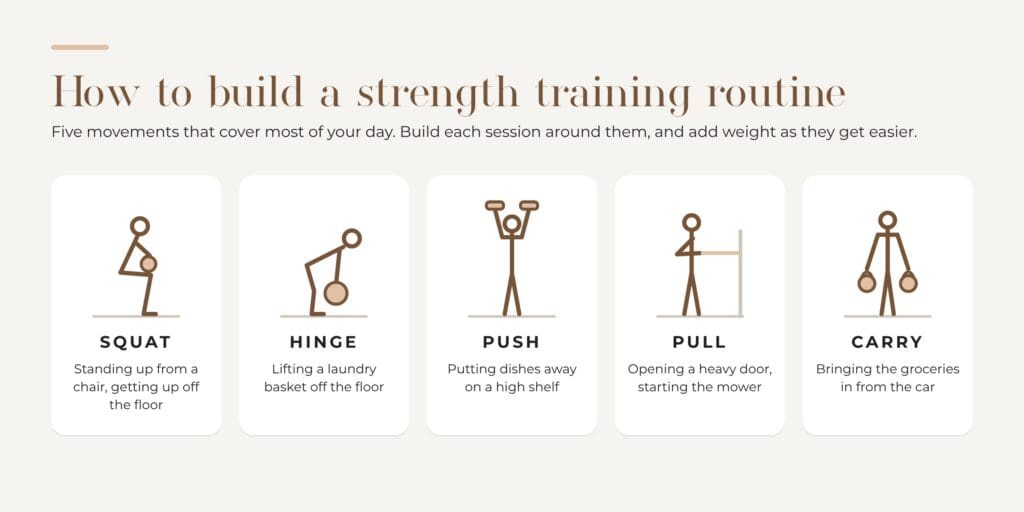
- Choose a weight that makes the last two reps hard. When you can do two more reps than you planned, add weight. That’s progressive overload, and it’s the step that’s easiest to skip at home.
- Get coached for the first month. LIFTMOR’s heavy lifting was supervised for a reason. Form first, then load. If you have osteoporosis, a past fracture, or back problems, start with your clinician and a qualified trainer.
- Keep moving in between, and eat protein at every meal. Walks and exercise snacks fill the days between sessions.
Want a baseline to go with your strength numbers? My free unBridled Longevity Blueprint™ Lab Guide covers the blood work: which markers to ask for in your 40s and 50s, and what each number can tell you.
Frequently asked questions
Four common signs of sarcopenia are a weaker grip, trouble standing up from a chair without using your arms, walking more slowly, and finding it harder to carry things or keep your balance. Grip strength and a five-rise chair test are the first screens in the 2019 European sarcopenia consensus. (1)
You prevent sarcopenia mainly with progressive resistance training two or more days a week, enough protein, and staying active between sessions. Strength training added about 1.1 kilograms of lean mass in roughly 20 weeks across 49 studies of adults aged 50 to 83. (4)
Low muscle mass can often be rebuilt with strength training, even later in life. In a review of 49 studies of adults aged 50 to 83, the oldest gained a little less, so the earlier you start, the more room you have. (4)
Heavy lifting has been studied in women with low bone mass. In the LIFTMOR trial, 101 postmenopausal women with low bone density lifted at more than 85 percent of their one-rep max under supervision, and the only reported injury was one minor back spasm. (6) Talk to your clinician first, and learn the lifts with a qualified coach.
I order a baseline DEXA scan at 45, so there’s a number to compare against later. It’s one marker, so read it next to how strong you are and what your blood work shows.
You’ll usually feel stronger before you see a change on a scan. Lean mass gains averaged 1.1 kilograms at about 20 weeks across 49 studies (4), and the bone density changes in LIFTMOR were measured at eight months. (6)
Where to start with sarcopenia and exercise this week
Do the chair test tonight and write down your time. Then put two strength sessions on next week’s calendar and pick a weight that makes the last reps hard. Sarcopenia and exercise come together right there: a measured starting point, a heavier load than you’re used to, and a retest in eight weeks.
If you want the blood work side of your baseline too, my free Lab Guide walks you through the markers to ask for.
Get the free unBridled Longevity Blueprint™ Lab Guide
This content is for informational and educational purposes only and is not intended as medical advice. Talk to your healthcare provider before starting a new exercise program.
References
- Cruz-Jentoft AJ, Bahat G, Bauer J, et al. Sarcopenia: revised European consensus on definition and diagnosis. Age and Ageing. 2019;48(1):16-31. https://doi.org/10.1093/ageing/afy169
- Janssen I, Heymsfield SB, Wang ZM, Ross R. Skeletal muscle mass and distribution in 468 men and women aged 18-88 yr. Journal of Applied Physiology. 2000;89(1):81-88. https://pubmed.ncbi.nlm.nih.gov/10904038/
- Greendale GA, Sternfeld B, Huang M, et al. Changes in body composition and weight during the menopause transition. JCI Insight. 2019;4(5):e124865. https://doi.org/10.1172/jci.insight.124865
- Peterson MD, Sen A, Gordon PM. Influence of resistance exercise on lean body mass in aging adults: a meta-analysis. Medicine & Science in Sports & Exercise. 2011;43(2):249-258. https://doi.org/10.1249/MSS.0b013e3181eb6265
- U.S. Department of Health and Human Services. Physical Activity Guidelines for Americans, 2nd edition (Executive Summary). 2018. https://odphp.health.gov/sites/default/files/2019-10/PAG_ExecutiveSummary.pdf
- Watson SL, Weeks BK, Weis LJ, Harding AT, Horan SA, Beck BR. High-intensity resistance and impact training improves bone mineral density and physical function in postmenopausal women with osteopenia and osteoporosis: the LIFTMOR randomized controlled trial. Journal of Bone and Mineral Research. 2018;33(2):211-220. https://doi.org/10.1002/jbmr.3284
- Kistler-Fischbacher M, Weeks BK, Beck BR. The effect of exercise intensity on bone in postmenopausal women (part 2): a meta-analysis. Bone. 2021;143. https://pubmed.ncbi.nlm.nih.gov/33357834/
- Csapo R, Alegre LM. Effects of resistance training with moderate vs heavy loads on muscle mass and strength in the elderly: a meta-analysis. Scandinavian Journal of Medicine & Science in Sports. 2016;26(9):995-1006. https://doi.org/10.1111/sms.12536
- Borde R, Hortobágyi T, Granacher U. Dose-response relationships of resistance training in healthy old adults: a systematic review and meta-analysis. Sports Medicine. 2015;45(12):1693-1720. https://doi.org/10.1007/s40279-015-0385-9
- Martyn-St James M, Carroll S. Meta-analysis of walking for preservation of bone mineral density in postmenopausal women. Bone. 2008;43(3):521-531. https://doi.org/10.1016/j.bone.2008.05.012
- Bauer J, Biolo G, Cederholm T, et al. Evidence-based recommendations for optimal dietary protein intake in older people: a position paper from the PROT-AGE Study Group. Journal of the American Medical Directors Association. 2013;14(8):542-559. https://doi.org/10.1016/j.jamda.2013.05.021


