


Medically reviewed by Jackie Giannelli, FNP-BC, MSCP
Menopause bloating is one of the most common and most maligned symptoms of midlife: you wake up in the morning, check the mirror, and you feel pretty good about your midsection…then as the day goes on, you start feeling like you’re three months pregnant. The good news is that there are things you can do to mitigate this bloating.
I’m Jackie Giannelli, a board-certified nurse practitioner who works with women in perimenopause and menopause. And I’m not here to hand you a list of supplements or tell you to go on a fad diet to fix your bloating. But I will explain to you why this is happening and what works for a lot of my patients when it comes to menopause bloating.
Before you blame “menopause” for any symptom, it’s worth knowing your numbers. My free Lab Guide decodes the markers I’d check for women 35+. Grab it here and get tracking.
What causes menopause bloating?
Menopause bloating comes from three things happening at once as estrogen and progesterone decline:
- Your digestion slows down
- Your body holds more water
- Your gut produces more gas
When all three stack together, your midsection puffs up like a balloon and your pants stop fitting by evening.
For some women, digestive changes can affect quality of life for years across perimenopause and menopause. That’s an extremely long time to battle your own body. So let’s talk about why it’s happening and some things you can do to fight it.
Your gut health and your hormones
Your gut is part of how your body regulates your hormones.
The problem is, when progesterone and estrogen start to drop during perimenopause and menopause, your gut seriously misses their presence.
Progesterone, which once used to relax smooth muscle (including the muscles that power digestion), now isn’t as abundant. Without its relaxing presence, gut motility slows. (1) Slower digestion means your food is sitting in your digestive tract longer, which leads to bacteria having more time to have a little party in there. That’s what causes the bloating.
Estrogen matters for digestion too: it helps maintain muscle tone throughout the gut, as well as gut microbiome diversity, so as estrogen falls, the whole system gets a little less efficient, compounding the loss of progesterone. (2)
So, the base of the problem is declining hormones, and that’s why you can cut out every possible food and still have bloating in menopause.
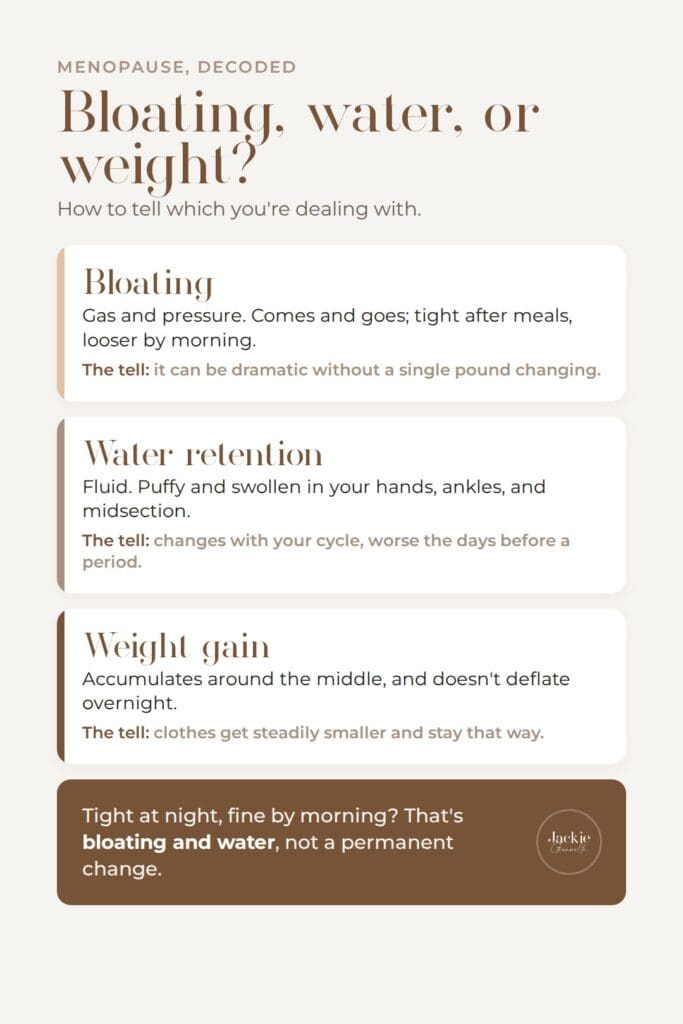
Is it bloating, water retention, or menopause weight gain?
Bloating is gas and pressure: it comes and goes throughout a day. Your stomach feels tight and distended after meals and looser by morning, and it can be dramatic without a single pound changing.
Water retention is fluid: it shows up as puffiness and a heavy, swollen feeling in your hands, ankles, and midsection, and in perimenopause it often rises and falls along with your cycle, worse in the days just before your period.
Weight gain behaves differently again: it is steady, it does not deflate overnight, and as estrogen falls it tends to settle around your middle rather than your hips and thighs.
Most women in peri/menopause have a combination of all three of these things going on. But if what’s really going on is bloating and you’re restricting food groups and calories like crazy and not seeing any real results, that’s because you’re targeting weight gain instead of bloat.
Let’s look at what to work on instead.
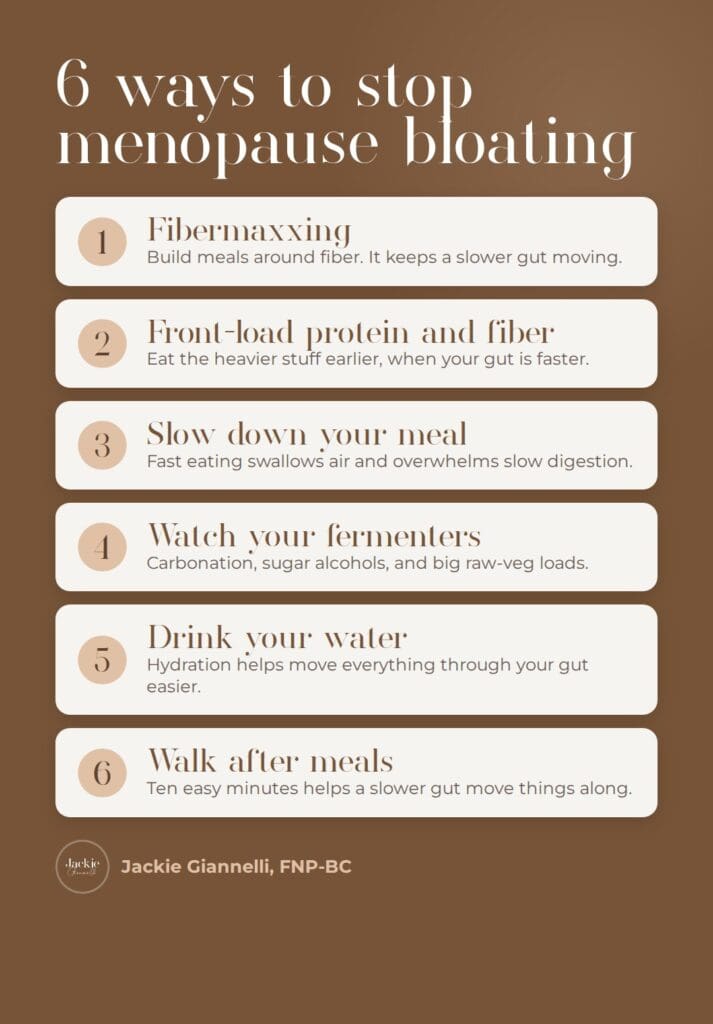
How to stop menopause bloating
Here’s the short list of what to work on to tackle menopause bloating.
- Fibermaxxing is the new cool girl, must-have flat belly hack. Fiber helps counteract all that slowing gut motility and keeps things moving on out. Plus, it helps with overall gut health, cholesterol, and blood sugar balance, too. (3)
- Front-load protein and fiber earlier in the day. A protein-forward breakfast and lunch give a slower gut more time to complete the heavier work before evening, when bloating often peaks.
- Slow the meal down. Eating fast swallows air and overwhelms slow transit. Plus, when your food isn’t thoroughly chewed, it’s harder to digest. So putting the fork down between bites and going slowly is essential. I know this is hard, because we’re all so stretched for time, and meals are a great place to get time back by rushing through. Seriously, though, you deserve to have a nice meal, sitting at a table and talking with people, not hunched over your phone sitting at your desk. Your digestion really will thank you for this shift.
- Find your own trouble fermenters. For a week, note what you ate on your worst bloat nights. Carbonation, sugar alcohols, and large amounts of raw veg all at once are very often the culprits.
- Keep water easy to reach. Hydration helps move everything through a slower system. Get yourself a fun cup you look forward to filling and gulp it down every day.
- Take a short walk after meals. Ten or fifteen minutes of easy movement after you eat helps a slower gut move things along, which means less time for food to sit and ferment. It’s one of the highest-return, lowest-effort things you can do for your body.
Does HRT help or cause bloating?
If your bloating is being driven by fluctuating estrogen or progesterone, steadying your hormones with HRT can help to settle it over time. Also, estrogen therapy may help with belly fat, too. (4)
But bloating is also one of the most common early side effects of starting hormone therapy itself, and it can come from either the estrogen or the progestogen.
The reassuring part is that these early side effects usually settle down. So a bloated first few weeks on HRT is not necessarily a signal that it’s not going to work for you.
What I tell patients is this. Don’t quit in week two over bloating, and don’t white-knuckle it for a year either. If it’s still rough after a few months, the type, the dose, or the delivery of the hormones can often be adjusted. That’s a conversation with a menopause-informed prescriber, not a reason to give up on a therapy that might be helping everything else.
When bloating isn’t just menopause
Most midlife bloating is hormonal, and it does often respond to the changes we’ve talked about here.
But bloating is also a symptom your body uses for other things, and a few patterns deserve a clinician’s eyes rather than a simple food swap. See a provider if your bloating is persistent and doesn’t come and go, if it comes with unexplained weight loss, ongoing abdominal or pelvic pain, a real change in your bowel habits, or bleeding. Persistent bloating can occasionally signal conditions like ovarian issues (5) or celiac disease (6), and those are worth ruling out.
Frequently asked questions
What causes menopause bloating?
Declining estrogen and progesterone slow your gut’s motility, increase water retention, and shift your gut bacteria toward more gas production. (7) The result is slower digestion, fluid retention, and more gas, which stack into the bloated feeling that tends to peak by evening.
Does menopause bloating ever go away?
For many women, it eases as hormones settle after menopause, but these digestive changes can run for years, often close to a decade across the transition. That long window is the reason to set up your eating habits now rather than waiting it out.
Is menopause bloating hormonal or is it my diet?
Both, and they interact. Your hormones changed how efficiently your gut runs; your diet and how you eat decide how hard that slower gut has to work each day. You can’t change the first from your kitchen. You can change the second.
What foods make menopause bloating worse?
The common culprits are carbonation, sugar alcohols, very large or fast meals, and big loads of fermentable foods (beans, raw cruciferous veg) all at once, because a slower gut ferments them longer. The specific ones are individual, so tracking your worst nights beats following a generic no-list.
Is my bloating actually weight gain?
Not usually, if it comes and goes. Bloating and water retention fluctuate across the day and often deflate overnight, while menopause weight gain is fat, so it’s steady and doesn’t change hour to hour. If your stomach is tight at night and flatter by morning, that’s bloating, not a permanent change.
Does HRT cause bloating?
It can, especially in the first weeks, from either the estrogen or the progestogen. These early side effects usually settle within about three months. If bloating on HRT is severe or lasts longer, the type or dose can often be adjusted, so raise it with your prescriber rather than stopping on your own.
When should I see a doctor about bloating?
If bloating is persistent rather than coming and going, or comes with unexplained weight loss, ongoing pain, a change in bowel habits, or bleeding, see a clinician. Those patterns can point to something other than hormones and are worth checking.
If you want this kind of clear, no-hype breakdown every week, come read In the Saddle, my newsletter, where I connect what’s happening in your body to what you can actually change at home. Candid. Clinical. Never fear-based.
This article is for informational and educational purposes only and is not medical advice. It isn’t a substitute for care from your own clinician. Talk to a menopause-informed provider about symptoms that concern you.
References
- Progesterone inhibitory role on gastrointestinal motility (review). PubMed, 2022. https://pubmed.ncbi.nlm.nih.gov/35344673/
- Sex hormones and functional gastrointestinal disorders in menopausal women. Frontiers in Endocrinology, 2026. Link
- U.S. Food and Drug Administration. Health claim: soluble fiber and coronary heart disease. 21 CFR 101.81. Link · Reynolds A, et al. Dietary fibre and whole grains in diabetes management. PLOS Medicine, 2020. Link
- Papadakis GE, et al. Menopausal hormone therapy is associated with reduced total and visceral adiposity (OsteoLaus cohort). J Clin Endocrinol Metab, 2018. Link
- Goff BA, Mandel LS, Drescher CW, et al. Development of an ovarian cancer symptom index. Cancer, 2007;109(2):221-227. https://pubmed.ncbi.nlm.nih.gov/17154394/
- Celiac Disease Foundation. Symptoms of celiac disease. Link
- Peters BA, et al. Menopause is associated with an altered gut microbiome and estrobolome. mSystems, 2022. Link


