


Medically reviewed by Jackie Giannelli, FNP-BC, MSCP
Every year when the clocks change, something in you shifts before you can name it. You’re up at 3 am. You’re snapping at your kid over a dish in the sink. You’re wired and exhausted at the same time, doing everything you did in July and somehow paying more for it.
I’m a nurse practitioner who treats midlife women, and I’ll tell you what I tell them: this is mostly physiological, it’s mostly seasonal, and a lot of it you can mitigate.
Before we get into it: all my best stuff goes to my newsletter first. In the Saddle is free, I send it once a week, and I’d love to have you.
Why fall does this to you
It starts with light. When the mornings go dark, the bright light that sets your body clock stops arriving on time, and the clock drifts. Your cortisol, which is supposed to spike in the morning and get you going, shows up late and flat. Your melatonin, which should rise at night, gets confused about when night even is. (1) That’s the foggy, low, weirdly-tired-but-buzzing feeling that lands every year like clockwork.
Then the house closes in. The windows shut, the heat kicks on, and you’re inside more than you’ve been since spring. Every input that used to have somewhere to go now stays in the room with you: the overhead lights blazing till bedtime, the TV on for company, the mail and the backpacks piling up on every surface. None of it feels like a problem on its own. But all of it keeps your system just a little bit switched on, all day.
Your nervous system and your hormones
We treat the nervous system and hormones like two separate problems. They’re not. In peri, they run in a continuous feedback loop.
Shifting hormones leave your nervous system with less buffer, so you’re more reactive than you used to be. Estrogen helps regulate serotonin, the chemical your mood and your stress resilience ride on. (2) But it runs the other way too. A nervous system stuck in a low-grade stress state makes your hormonal symptoms worse.
High cortisol fragments sleep that was already fragile. It can make hot flashes and night sweats feel worse. It drags on the same mood and focus you’re fighting to hold onto.
In other words, your stress response system and your sex hormones aren’t politely taking turns. They’re pulling on each other all day.
Here’s why that’s good news. It means calming your nervous system isn’t the soft, optional, light-a-candle part of your health. It’s one of the few levers that loops back and eases the hormonal stuff too. Lower the stress load, and you don’t just feel less frazzled; you sleep deeper, and better sleep is one of the most reliable ways to take the edge off peri symptoms.
Calming your nervous system is hormone care. It should earn a real spot on your to-do list.
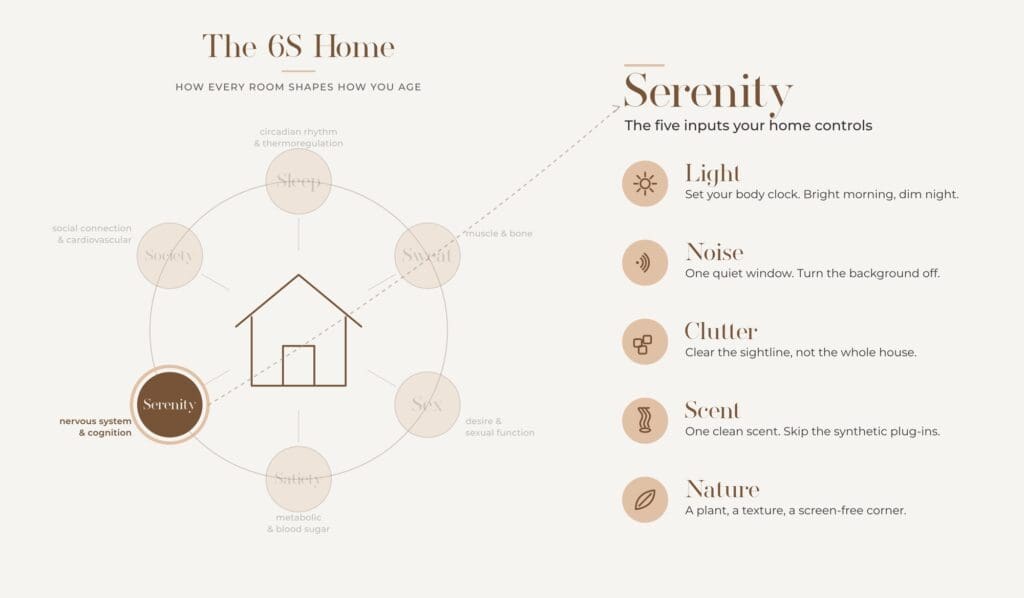
5 ways to reset your nervous system
At 35, your body soaked up a loud, bright, cluttered house for free. It doesn’t anymore, but that also means the small stuff moves the needle now in a way it never used to.
Here’s the way I think about it: your home runs five inputs on your nervous system: light, noise, clutter, scent, and nature.
When you address each one of these in a meaningful way, you can seriously lower the load on your stress response.
Here’s how to do it.
1. Light
Get real light in your eyes in the morning, ideally outside for a few minutes even when it’s gray, because a cloudy morning outdoors is still way brighter than your kitchen.
Then flip it at night: turn the overhead lights off after dinner.
This is such an underrated way to hand your body “it’s daytime” and “it’s night now” signals. If your winters go really dark and your mood goes with them, a morning light therapy lamp is worth asking your provider about. (3)
2. Noise
We’re surrounded by noise all day, and that grates on your nervous system. When you keep the TV on for company and the notifications constantly pinging, it keeps your system half-listening even when you think you’re relaxing.
The fix: give yourself one genuinely quiet window at night. Ten minutes with the background noise completely off. Leave the ringer off. Set your phone’s nighttime focus to begin early. Oh, and don’t check those emails before bed.
3. Clutter
Did you know that the state of the space you sit in every night tracks with your stress the next day? (4)
Yes, the mail in a pile by the front door. The packages you’ve yet to open. The dishes in the sink. They’re all actually creating a mental to-do list for your nervous system.
Now, instead of decluttering the whole house, start with just clearing the one surface you actually look at from where you rest: your nightstand, or the view from your side of the couch. Give your eyes somewhere to land that feels serene, and your nervous system will thank you.
4. Scent
Scent runs straight to the part of your brain that handles emotion, which is why a smell can settle you or wind you up faster than you can explain.
Pick one scent that makes you feel cozy and calm for the spot where you wind down. Skip the synthetic plug-ins, though. Those are not ideal for your hormones or your health. Try an essential oil diffuser or a simmer pot on the stove with a few slices of lemon and sprigs of rosemary instead.
5. Nature
We all could use more outside time, but it’s pretty simple to bring the outside in.
For starters, keep one corner or one room of the house screen-free.
Then, bring in something you can touch, something alive. A simple plant or cut flowers from the grocery store work perfectly.
When you’ve been staring at devices since six in the morning, these options give you a real place to land, and help your body read “safe and calm” faster than you’d think.
Seasonal depression is real
A slight seasonal dip is normal, and giving your home environment a glow-up during this time can certainly help.
But if your low mood is deep, sticks around most of the day for weeks, or takes your sleep, appetite, or interest in things down with it, that’s a conversation you absolutely need to have with your provider. (3)
Tend your environment because it lifts your baseline. Get real support when the baseline drops out from under you.
Love intentional design?
I’m spending the fall walking through my house this way, room by room, and explaining why each of my healthy choices earns a place in my new house. Get in on all the good stuff in my newsletter, In the Saddle. It’s free!
Today, you can start with one thing: get some light in your eyes in the morning, and kill the overhead lights after dinner. Your nervous system will notice.
References
- Scheer FAJL, Buijs RM. “Light Affects Morning Salivary Cortisol in Humans.” Journal of Clinical Endocrinology & Metabolism, 86(1):151, 2001. https://academic.oup.com/jcem/article-abstract/86/1/151/2841140?redirectedFrom=fulltext
- Amin Z, Canli T, Epperson CN. “Effect of Estrogen-Serotonin Interactions on Mood and Cognition.” Behavioral and Cognitive Neuroscience Reviews, 4(1):43-58, 2005. https://journals.sagepub.com/doi/10.1177/1534582305277152
- National Institute of Mental Health. “Seasonal Affective Disorder.” https://www.nimh.nih.gov/health/publications/seasonal-affective-disorder
- Saxbe DE, Repetti R. “No Place Like Home: Home Tours Correlate With Daily Patterns of Mood and Cortisol.” Personality and Social Psychology Bulletin, 36(1):71-81, 2010. https://journals.sagepub.com/doi/10.1177/0146167209352864 864


