


Medically reviewed by Jackie Giannelli, FNP-BC, MSCP.
You slept eight hours and still feel like you didn’t. You’re wired at 11 pm, wide awake at 3 am, and flattened by 3 pm. If that’s you, perimenopause sleepiness has a real physiological cause: a changing hormonal system meeting a bedroom that wasn’t built to help it. You can’t do much about the hormones this week, but you can change your room tonight.
Before we go further: if you want the weekly version of clinical-but-human guidance like this, In the Saddle is my free newsletter for midlife women who are ready to take control of their longevity, on their own terms.
Now, let’s talk about your bedroom.
Why perimenopause sleepiness is a nighttime problem you feel during the day
Here’s the truth. The exhaustion you feel at 2 in the afternoon usually started the night before, in the hours your sleep got quietly fragmented without fully waking you up. You don’t remember every micro-wake. But you certainly inherit the deficit the next day.
And you won’t believe how common this is. More than 40% of perimenopausal women report sleep problems, and pooled data put it around 55% after menopause. (1)(2) This is one of the most reliable signals that the menopausal transition has begun, and it’s also one of the least talked-about during your annual fifteen-minute gyno appointment.
What’s actually changing (estrogen, progesterone, and your internal thermostat)
Two hormones are doing most of the work here, and they’re moving in ways that make sleep harder.
Progesterone has a calming, sedative quality. It works on the same GABA pathways that help your nervous system settle. As it declines and starts swinging week to week in perimenopause, one of your body’s built-in “downshift” signals gets weaker. (2)
Estrogen matters for a different reason: it helps regulate your core body temperature. As estrogen fluctuates, your internal thermostat gets twitchy, which is the mechanism behind night sweats and the 3am furnace feeling. (2) Here’s the kicker: research links lower estradiol and higher FSH to disrupted sleep whether or not a woman has night sweats. (3) So even if you’re not soaking the sheets, the hormonal shift is still likely reaching into your sleep.
This is where you can get control of perimenopause and sleep. By changing the room you sleep in.
Your bedroom is either helping or fighting your hormones
How your bedroom is set up is important. Not because of aesthetics, although sure, that’s fun, too. But because the bedroom is where you spend a third of your life doing the single most important recovery work your body does.
When your thermostat is already unstable and your calming hormone is on the decline, small environmental inputs get louder. A room that’s two degrees too warm, a sliver of streetlight, a phone six inches from your face: none of these would matter much at 25. In perimenopause, when the system has less margin, they’re the difference between deep sleep and the shallow, broken kind that leaves you sleepy all day.
The five bedroom rules for deep sleep in perimenopause
Do these in order. The first two do most of the heavy lifting, and none of them require replacing your whole bedroom.
Rule 1: Get the temperature right
Your body has to drop its core temperature by about two degrees to fall and stay asleep, and that drop is part of what triggers melatonin release in the first place. (4) A warm room blocks the very signal your brain is trying to send. In perimenopause, when your thermostat is already misfiring, this is the highest-leverage change you can make.
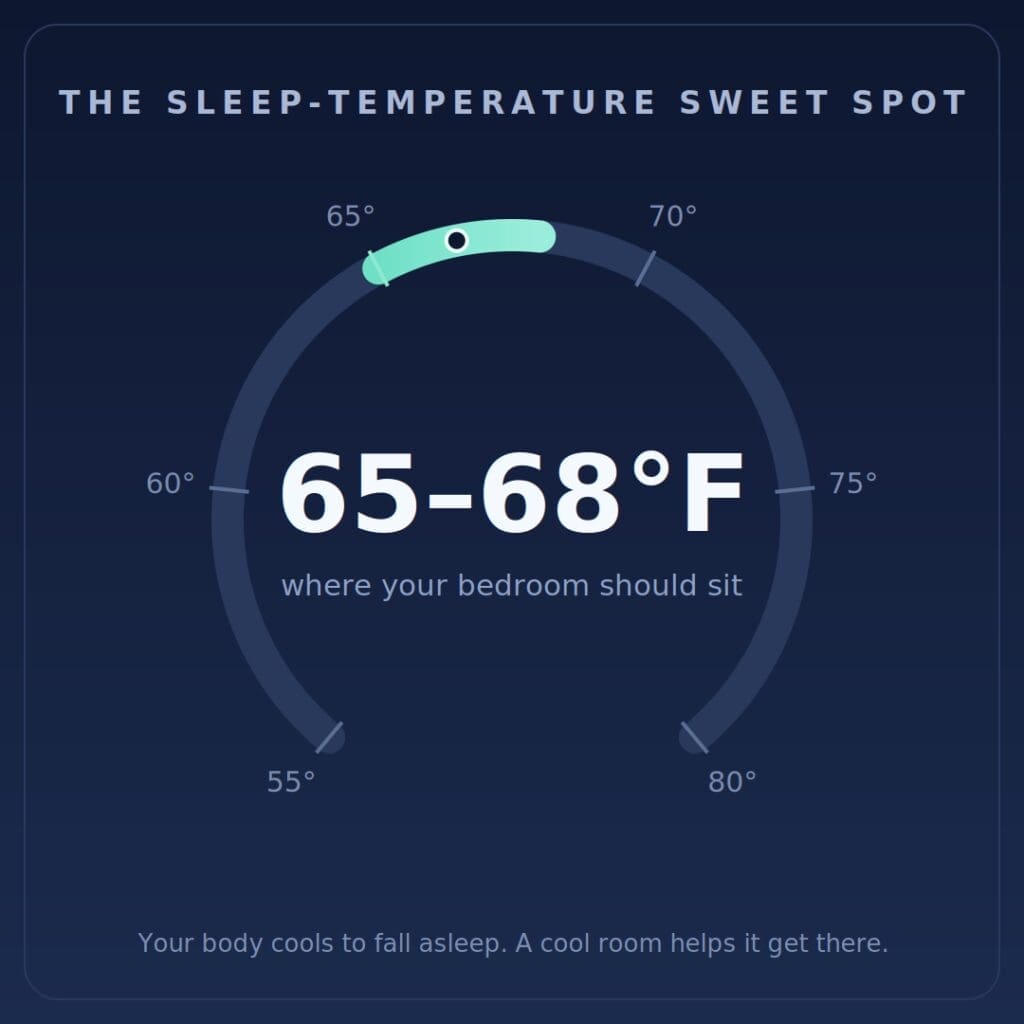
The research-backed range for the best bedroom temperature for sleep is roughly 65 to 68°F. (4) This is cooler than most people keep their house, and yes, that’s the point. If you run hot or wake up flushed, aim for the lower end, and let breathable bedding do the rest (see Rule 4 below).
Rule 2: Kill the light, all of it
Light is the master switch for your circadian clock. Even ordinary room light in the hour before bed can suppress melatonin and push your internal clock later. (5) That little glow from the streetlight, the charging LED, the hallway: your brain reads all of it as a low-grade “stay awake” signal.
Two moves. First, dim the house after dinner. Warm, low lamps instead of overhead lights tell your body the day is ending. Second, make the bedroom truly dark: blackout curtains, and cover or move the little electronic lights that dot most bedrooms. If waking at 3am is your pattern, this is the rule I’d have you fix right after temperature.
One caveat worth knowing: blackout curtains are a nighttime tool, not an all-day one. Morning light is the strongest signal your body uses to end sleep and set your clock for the day, so if you black the room out, make sure you’re getting bright light back in soon after you wake. Open the curtains first thing, or step outside with your coffee. If your room is fully dark and you tend to sleep through your alarm, a sunrise-style lamp that brightens gradually gives your body that wake cue without undoing the dark room you built for sleep. Programmable blinds can be a huge help, too.
Rule 3: Get screens out of arm’s reach
Screens are a light problem and a stimulation problem stacked together. Using a light-emitting device in bed delays melatonin, pushes back your circadian timing, and leaves you less alert the next morning. (6) That last part is the direct line to perimenopause sleepiness: the scroll costs you more than the time you spent on it, because it degrades the quality of the sleep that follows.
You don’t have to be perfect. Move the charger across the room so checking your phone at 3am takes actual effort, and give yourself a screen-free landing strip of even twenty minutes before lights out.
Rule 4: Rethink what’s touching your skin all night
If night sweats or the 3am furnace feeling are waking you, the surfaces against your skin may matter more than almost anything else in the room. Synthetic sheets and heavy synthetic-fill bedding trap heat and hold moisture against you. Breathable natural fibers, like cotton, linen, or even a wool mattress pad for temperature buffering, help your body shed heat instead of stewing in it.
What’s more: your skin is in contact with your bedding for more hours than with any other product you own. If you’re working to lower your overall load of fragrance and additives (the way I walk through in how to detox your home, room by room), fragrance-free laundry detergent for your sheets is a high-contact place to start.
Rule 5: Make the air breathable
A closed-up bedroom accumulates stale, stuffy air overnight, and stuffiness fragments sleep in ways you feel but can’t quite name. You don’t necessarily need a gadget. Crack a window when the weather allows, run a fan for air movement and a little cooling, and if you want to go further, a simple HEPA purifier helps in rooms with poor airflow. This is the lowest-priority rule for a reason, but it’s an easy win once the first four are handled.
What you can stop worrying about
I’m not here to hand you a 14-step nightly routine. And you do not need a $3,000 mattress, or a cabinet of supplements and melatonin gummies to start getting great sleep.
You need a cool, dark, screen-light-free room with breathable sheets. Fix the temperature and the light first, give it a couple of weeks, and see how much of the daytime sleepiness lifts before you spend a dollar on anything fancier.
The honest bottom line on perimenopause sleepiness
Perimenopause sleepiness is real, and it’s physiological. Your hormones are changing the terrain: less of the calming one, a wobblier internal thermostat, a circadian system with less margin for error.
So changing your bedroom is the simplest place to start. Keep it cool, dark, screen-free, breathable, ventilated.
In the Saddle: the weekly version of this
In the Saddle is where I do this kind of thing every week: clinical guidance for midlife women, translated into plain English, with zero fear-mongering. It’s free, and it’s written for the woman who’s tired of being told her labs are normal while she feels anything but.
Subscribe to In the Saddle → and I’ll meet you in your inbox.
Daytime perimenopause sleepiness is usually the downstream effect of fragmented nighttime sleep. Shifting estrogen and declining progesterone disrupt your sleep architecture and your temperature regulation, so you wake more often (sometimes without fully remembering it) and inherit the deficit the next afternoon. (2)(3)
Research supports roughly 65 to 68°F as the best bedroom temperature for sleep, because your body needs to drop its core temperature to fall and stay asleep. (4) If you run hot or wake up flushed, aim for the lower end and pair it with breathable, natural-fiber bedding.
The experience overlaps, but perimenopause insomnia has specific hormonal drivers: less progesterone (which has a natural sedative effect) and fluctuating estrogen (which destabilizes temperature and can trigger night sweats). (2) Lower estradiol has been linked to disrupted sleep even in women without night sweats. (3)
Bedroom changes and medical care aren’t competing options. Optimizing temperature, light, screens, and bedding removes the environmental factors that make sleep worse, which helps regardless of what else you do. If sleep stays badly disrupted, that’s worth discussing with a clinician who treats midlife women. This post is educational and not medical advice.
Give a cooler, darker, screen-free room a couple of weeks of consistency before judging it. Circadian and thermoregulatory changes settle in over days, not one night, so consistency matters more than any single perfect evening.
References
- Park KM. “Sleep Disturbance in Perimenopausal Women.” Chronobiology in Medicine. 2024. https://www.chronobiologyinmedicine.org/m/journal/view.php?number=182
- Salari N, Hasheminezhad R, Hosseinian-Far A, et al. “Global prevalence of sleep disorders during menopause: a meta-analysis.” Sleep and Breathing. 2023;27(5):1883-1897. https://link.springer.com/article/10.1007/s11325-023-02793-5
- Baker FC. “It’s Not Just About the Hot Flashes: Menopausal Hormone Changes and Disrupted Sleep.” J Clin Endocrinol Metab. 2023;108(2):e25-e26. https://academic.oup.com/jcem/article/108/2/e25/6776160
- Sleep Foundation. “The Best Temperature for Sleep.” https://www.sleepfoundation.org/bedroom-environment/best-temperature-for-sleep
- Gooley, J.J., et al. “Exposure to Room Light before Bedtime Suppresses Melatonin Onset and Shortens Melatonin Duration in Humans.” Journal of Clinical Endocrinology & Metabolism, 2011. https://pubmed.ncbi.nlm.nih.gov/21193540/
- Chang, A.M., et al. “Evening use of light-emitting eReaders negatively affects sleep, circadian timing, and next-morning alertness.” PNAS, 2015. https://www.pnas.org/doi/10.1073/pnas.1418490112


