


Medically reviewed by Jackie Giannelli, FNP-BC, MSCP.
You did the informed thing. You saw “BPA-free” on the water bottle and the food containers, and you bought those instead. So here’s the uncomfortable part: that label was never a promise that your plastics were hormone-safe. Yes, unfortunately, BPA is not the only endocrine disruptor in plastics.
I went down this rabbit hole reading labels in my own kitchen, and I want to save you the time (and the accompanying feeling of panic). Here’s the full run-down.
What “BPA-free” actually means (and what it doesn’t)
Bisphenol A, or BPA, is a chemical used for decades to make hard, clear plastics and the lining inside cans.
It’s an endocrine disruptor, which means it can mimic or interfere with your body’s own hormone signaling, and it’s been associated with reproductive issues, altered brain development, and certain hormone-driven cancers. (1)
Public pressure built, countries restricted it from baby bottles, and manufacturers scrambled to slap “BPA-free” on everything.
But here’s the thing: “BPA-free” only tells you that one specific molecule is absent. It says nothing about what got used in its place. And what got used in its place is frequently a chemical cousin that behaves almost exactly the same way in your body. The label solved a public-relations problem while leaving the health question wide open.
Meet BPS and BPF: the stand-ins that act just like the thing they replaced
When BPA got a bad name, the two most common replacements were bisphenol S (BPS) and bisphenol F (BPF). Structurally, they’re close relatives. As geneticist Patricia Hunt put it, they “look a lot like BPA,” so “it stands to reason that they’re going to behave a lot like BPA.” (2)
This is what the data keep showing.
BPS vs BPA: what the research actually shows
If you’re weighing BPS vs BPA, hoping one is clearly the safe choice, I’ll give you the short answer: the evidence doesn’t support that hope. A systematic review in Environmental Health Perspectives looked at the research on BPS and BPF and found they are similarly hormonally active to BPA, with comparable potency across the hormone-signaling effects studied. (3) In other words, swapping BPA for BPS is often swapping a disruptor for another disruptor wearing a different name tag.
So when you ask “is bpa free safe,” the honest clinical answer is: not automatically, and not because of the label alone. BPA-free can still mean bisphenol-something, and the something isn’t necessarily better.
Why this keeps happening (the “regrettable substitution” trap)
There’s actually a term for this pattern. Researchers call it “regrettable substitution”: a chemical of concern gets replaced by one that’s barely tested, structurally similar, and ends up carrying the same risk. NYU’s Leonardo Trasande described the whole dynamic as a losing game of “chemical whack-a-mole.” (2)
The reason it persists is regulatory, not scientific. In the United States, a new chemical doesn’t have to be proven safe before it goes into the products you buy; concern generally has to be demonstrated after the fact. So the burden lands where it always lands in women’s health: on you, doing the homework the system didn’t. I stand by my POV that this is backwards. But until it changes, knowing what to look for is the lever you actually control.
Why endocrine disruptors in plastics matter more in perimenopause
Your endocrine system runs on precise, low-dose hormone signals. In your late 30s and 40s, those signals are already shifting as you move toward menopause, so estrogen and progesterone are fluctuating week to week. Drop estrogen-mimicking compounds into that environment, and you’re adding noise to a signal that’s already changing. Many bisphenols and phthalates act as xenoestrogens, meaning they can imitate estrogen at the receptor, and phthalates specifically have been associated with disrupted thyroid function and earlier menopause. (1) BPA exposure has also been associated with Polyendocrine Metabolic Ovarian Syndrome (formerly known as Polycystic Ovary Syndrome or PCOS). (1)
I’m not telling you plastic causes your perimenopause. It doesn’t. What I’m telling you is that when your hormones are already recalibrating, lowering the added estrogenic load is one of the few inputs sitting entirely within your reach.
It’s not just the additives: microplastics in food
There’s a second layer, and it’s newer. Beyond the chemicals added to plastic, the plastic itself breaks into micro- and nanoparticles that end up in what we eat and drink. Research on microplastics in food has documented these particles in seafood, salt, bottled water, and, increasingly, in human tissue, including studies detecting microplastics in every placenta sampled. (4)
Two habits drive most of your everyday exposure: heat and abrasion. Microwaving food in plastic and pouring hot liquid into plastic both accelerate how much migrates into what you consume, and scratched, worn containers shed more than smooth glass ever will. (5)
What to actually look for in your plastics
Okay, the useful part. You don’t need a chemistry degree here, and you don’t need to bag up and toss out your whole kitchen.
The labels worth trusting
Skip “BPA-free” as your deciding factor. It’s a starting point that doesn’t tell you enough on its own. Instead:
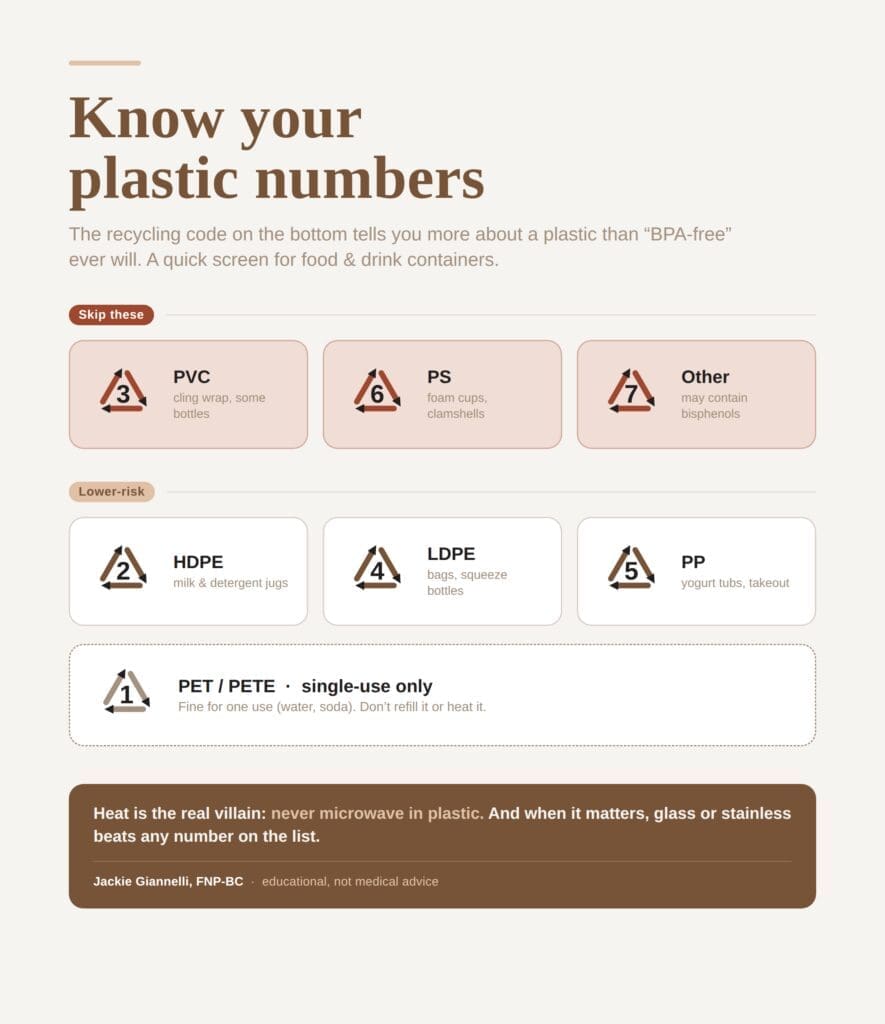
Look at the recycling number on the bottom. As a rough screen, plastics marked 3 (PVC), 6 (polystyrene), and 7 (a “other” catch-all that historically included bisphenols) are the ones I’d avoid for food and drink. (2) Numbers 2, 4, and 5 are generally considered lower-risk for food contact, though “lower-risk plastic” still isn’t “glass.”
For products you’d rather vet than guess on, a barcode-scanning app that rates ingredients (Yuka is the one I point patients to) takes the label-reading off your plate at the store.
The three swaps that matter most
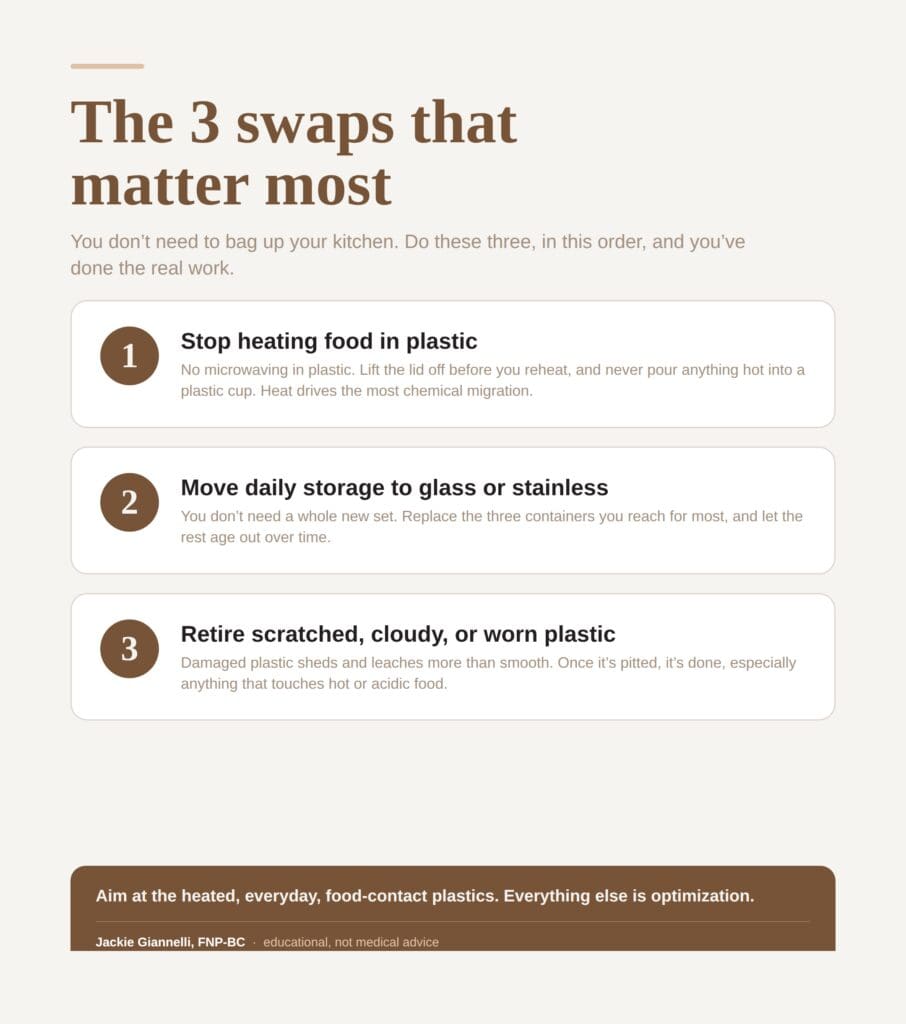
If you do nothing else, do these, in this order:
- Stop heating food in plastic. No microwaving in plastic containers, and lift the plastic lid off before you reheat. Heat is the single biggest accelerant of chemical migration. (5)
- Move your most-used food storage to glass or stainless steel. You don’t need a whole new set. Replace the three containers you reach for daily; let the rest age out.
- Retire scratched, cloudy, or worn plastic. Damaged plastic sheds more particles and leaches more. Once it’s pitted, it’s done, especially anything that touches hot or acidic food.
Everything else is about optimization.
What you can stop stressing about
You do not need to panic about touching a plastic clamshell at the store, holding a plastic pen, or the existence of plastic in your life at all. The dose and the route matter. A cool, dry container holding your dry pasta is not the same exposure as a scratched tub you microwave lasagna in twice a week. Chase the daily, heated, food-contact plastics and let the rest go. Plastics are really just one corner of this. If you want the same triage for the whole house, here’s how to detox your home, room by room.
The honest bottom line on endocrine disruptors in plastics
“BPA-free” was a marketing answer to a health problem. The endocrine disruptors in plastics that matter for your hormones didn’t leave when BPA did; some of them just changed initials. A handful of cheap, boring swaps, aimed at the heated, everyday, food-contact plastics, meaningfully lowers the estrogenic load your body carries while it’s already busy running the rest of your life.
No. “BPA-free” only means that one specific chemical, bisphenol A, is absent. It says nothing about the replacement, which is often BPS or BPF, chemical relatives that research shows are similarly hormonally active. (3) Treat the label as a starting point, not a guarantee.
The evidence doesn’t support calling it safer. A systematic review found BPS and BPF have hormone-disrupting activity comparable to BPA. (3) In the bps vs bpa comparison, you’re generally trading one endocrine disruptor for a close cousin, not upgrading to a safe option.
As a rough screen, avoid recycling numbers 3, 6, and 7 for food and drink, and avoid any plastic that’s scratched, cloudy, or worn. (2) The bigger rule is behavioral: don’t heat food in plastic, and move daily-use storage to glass or stainless steel.
Microplastics have been detected in seafood, salt, bottled water, human tissue, and the Mariana Trench. Researchers are actively studying their effects on hormone and reproductive health. (4) You can lower your everyday intake meaningfully by cutting heat-plus-plastic contact and replacing worn containers.
Because your hormones are already fluctuating as you approach menopause, and estrogen-mimicking compounds add extra noise to a signal that’s recalibrating. Some bisphenols and phthalates act as xenoestrogens and have been associated with thyroid disruption and earlier menopause. (1) Lowering the added load is one input you can actually control.
References
- Endocrine Society. “Plastics, EDCs & Health.” https://www.endocrine.org/topics/edc/plastics-edcs-and-health
- Zimmerman, R. “Is BPA-Free Plastic Safe? Get the Facts.” National Geographic. https://www.nationalgeographic.com/science/article/news-BPA-free-plastic-safety-chemicals-health
- Rochester, J.R., & Bolden, A.L. (2015). “Bisphenol S and F: A Systematic Review and Comparison of the Hormonal Activity of Bisphenol A Substitutes.” Environmental Health Perspectives, 123(7), 643-650. https://ehp.niehs.nih.gov/doi/full/10.1289/ehp.1408989
- Garcia, M.A., et al. (2024). “Quantitation and identification of microplastics accumulation in human placental specimens using pyrolysis gas chromatography-mass spectrometry.” Toxicological Sciences, 199(1), 81-88. https://doi.org/10.1093/toxsci/kfae021
- Massahi, T., et al. (2025). “A simulation study on the temperature-dependent release of endocrine-disrupting chemicals from polypropylene and polystyrene containers.” Scientific Reports, 15, 19318. https://doi.org/10.1038/s41598-025-05036-7


