


Medically reviewed by Jackie Giannelli, FNP-BC, MSCP
Supplements for women over 40 tend to get promoted as miracle cures. Ashwagandha for “cortisol belly,” adrenal support gummies for energy, maybe berberine as a stand-in for Ozempic. You buy one, then another, and one morning you open the supplement cabinet and count eleven bottles.
You get overwhelmed, so you stop taking them. Or you can’t remember why you ordered them in the first place.
Now, I love a good supplement. I do. But what I don’t love is when women get taken advantage of during vulnerable hormonal transitions by predatory marketing claims.
And I believe in creating a holistic plan for your supplements, not just taking them and never evaluating what they’re actually doing for your labs or your quality of life.
So here’s how I judge which ones earn their place.
My free guide, The Cool Girl Stack, walks you through what to test and what to ask before you add anything new. Get the Cool Girl Stack here.
Do supplements actually work for women over 40?
Some supplements do a specific job well, and that job should be correcting a nutrient you’re low in.
Much of what ends up in your supplement drawer has never been shown to do what the label implies for a woman who isn’t deficient. For me, the deciding question is whether a measured number from a test, or a clear gap in your diet, put that supplement bottle into your stack.
But you’re in good company if the answer is “I’m not sure.” The CDC’s National Center for Health Statistics found that 63.8% of American women had taken at least one supplement in the past month, and 80.2% of women 60 and over had. (1)
The most commonly taken supplement is a multivitamin, so let’s talk about them.
The U.S. Preventive Services Task Force looked at the research in 2022 and found the evidence insufficient to say whether a multivitamin helps prevent heart disease or cancer. It recommended against vitamin E and beta-carotene supplements for that purpose as well. (2)
The problem is, a lot of multivitamins are poor quality and have fillers in them. And most people aren’t great at taking them regularly.
So, a high-quality multivitamin can still cover gaps in your diet. I just wouldn’t buy one to protect your heart or lower cancer risk, or pay extra because the packaging hints that it can.
Hold everything else in the supplement drawer to the same two questions: what is it for, and how would you know it’s working?
Which supplements for women over 40 are worth taking?
Again, the supplements I take most seriously after 40 are the ones where a lab result or a real gap in your diet makes the call. Vitamin D, iron, vitamin B12, and omega-3s all sit in that group.
I never recommend calcium supplements unless someone has a real nutritional deficiency. Some meta-analyses and clinical trials have suggested that high-dose calcium supplements may increase the risk of cardiovascular events, such as heart attacks and coronary heart disease, particularly in healthy postmenopausal women. Calcium is really best gotten through diet alone! (9)
Everything else needs a reason you can say out loud in one sentence.
| Supplement | What decides it | What to check for |
|---|---|---|
| Vitamin D | Your blood level | A 25-hydroxyvitamin D test |
| Iron | Your iron stores, and only if they’re low | Ferritin and total iron-binding capacity + transferrin saturation |
| Vitamin B12 | Your level, your diet and your medications | A B12 level, especially if you eat plant-based or take metformin or an acid-reducing medication |
| Omega-3 (fish oil) | How often you eat fatty fish | How many times a week salmon, sardines, or trout make it onto your plate |
| Calcium | How much you already get from food | Add up dairy, leafy greens, and fortified foods before adding a pill. Food first is best, and I never recommend calcium supplements unless someone has a real nutritional deficiency. |
Notice what’s missing from the table: anything that promises to “balance your hormones,” detox your liver, fix cortisol levels, or boost your metabolism. Those are the bottles I’d question first, ashwagandha and berberine included.
If there’s a protein powder in your stack, it can certainly earn its place. I’d still get most of your protein from food first. I covered how much you need alongside strength training to protect muscle and bone in this article.
Iron supplements in peri+menopause
Iron deserves a closer look in peri, especially since some multivitamins include it.
If you’re exhausted after eight hours in bed, finding more hair in the shower drain, or getting winded on stairs you used to take without thinking, check your ferritin before you blame your age. Heavier periods, or periods that come closer together, can drain your iron stores.
A routine complete blood count (CBC) won’t always catch it. A CBC shows your hemoglobin, the iron circulating right now, like the cash in your wallet. Ferritin shows your stored iron, the savings account. You can run that savings account close to zero long before your hemoglobin drops low enough to count as anemia.
In September 2026, the American Society of Hematology raised its ferritin cutoffs for diagnosing iron deficiency: 30 ng/mL or lower for menstruating women, and 50 ng/mL or lower if you have heavy periods. (8) If your last ferritin came back at 18, it’s worth a second look under the new numbers.
After menopause, your iron needs drop, and your body has no easy way to get rid of the extra.
So iron is the one I never want taken “just in case.” Test first.
Are menopause supplements worth it?
For hot flashes and night sweats, the evidence behind supplements and herbal remedies is rather weak. The Menopause Society’s 2023 position statement on nonhormone therapy reviewed the options and did not recommend supplements or herbal remedies for hot flashes. (3) The same review left a short list of prescription and behavioral options that do have evidence.
Hormone therapy is still the most effective treatment for hot flashes and night sweats. That’s the conversation I’d want you having first, before trying another “menopause blend.”
So if you’re working through black cohosh, maca, and a hormone-balancing gummy and still waking up soaked, I’d rather you put that energy into a real plan with a menopause-trained clinician. If you’re weighing hormone therapy, here’s how long hormone therapy takes to work, so you know what a fair trial looks like.
How can you tell if a supplement is good quality?
Supplements don’t go through FDA approval for safety or effectiveness before they’re sold. So the label is the manufacturer’s word, and it stays that way until someone tests the bottle. (4)
And when researchers do test, the labels don’t always hold up.
In a 2022 study in JAMA Network Open, researchers bought 30 immune-support supplements on Amazon, and 17 had inaccurate labels. Thirteen were missing an ingredient the label listed, and nine contained something it didn’t list. (4)
Melatonin gummies were worse. A 2023 study in JAMA tested 25 brands, and 22 were mislabeled. The actual melatonin ranged from 74% to 347% of what the bottle claimed, and one had no melatonin at all, only CBD. (5) That’s a wide range for something you take at bedtime on the bad-sleep nights of peri.
So how do you protect yourself? Check three things: the seal, the label, and the blend.
The seal on the bottle
A USP Verified or NSF seal is the fastest shortcut. USP tests products their makers submit against standards for quality, purity, potency, and consistency, and audits how they’re made. (6) NSF runs a similar program. The seal tells you the bottle matches its label. Whether you need what’s inside is still a question for you and your labs.
How to read a supplement label
No seal? The Supplement Facts panel is your next check. Start with the serving size, because “per serving” sometimes means two or three capsules. Then look at how much of each ingredient you’re getting and in what form, like vitamin D3 or magnesium glycinate. Watch the % Daily Value column for anything well over 100%, especially vitamin A, vitamin D, and iron, where more can do harm.
Proprietary blends
If the panel says “proprietary blend,” slow down. A blend lists one total weight for a group of ingredients without saying how much of each is inside. You can’t judge a dose you can’t see, so I’d put that bottle back.
How do you know if a supplement you’re already taking is doing anything?
Give every supplement a job, then check whether it’s doing it. Write down what you expected it to change, wait four to eight weeks, and look again at the symptom or lab result that started it. If you can’t say what the job was, that’s your answer.
The mistake I see most with supplements for women over 40 is starting three things in the same week. Your sleep gets better, and you have no idea which one did it.
In peri, your symptoms already shift with your cycle, so a good week might just be a good week. Add one thing at a time, and jot your cycle day next to how you feel so you can see the pattern over a full month.
One bottle to mention before your next blood draw
Some supplements can also change the lab results you’re using to judge them. Biotin is the big one. In a 2021 study in the journal Thyroid, 13 adults took 10 mg of biotin a day for eight days, and it threw off TSH, free T4, and other thyroid results on some lab equipment. (7) Hair, skin and nail supplements usually contain 2 to 20 mg. (7)
That matters in peri, because thyroid symptoms and perimenopause symptoms overlap: fatigue, hair changes, weight that won’t budge. A false thyroid result can send you down the wrong path. Tell whoever orders your labs that you take biotin, and ask how long to stop it before the draw.
When should you stop a supplement?
Stop a supplement when you can’t name its job, when the lab result that started it is back in range and your clinician agrees, or when it might interact with something you’re prescribed. The women doing best in my practice take things out as deliberately as they put them in.
Interactions between supplements are something to consider as well, because whether a supplement is safe for you depends on what else you take. St. John’s wort can make several medications less effective, including some hormonal birth control. Calcium and iron can block thyroid medication if you take them at the same time. High-dose fish oil matters if you take a blood thinner or have surgery coming up. Your clinician can only check what they know about, so bring the whole list, or bring the bottles themselves.
And if you’re looking at that supplement drawer and adding up what you’ve spent, that money still bought you something: information about what does and doesn’t work for your body. Write down what each bottle did, and ask the same question I ask of the longevity tests I’d skip: will this change how you feel and function in your 60s?
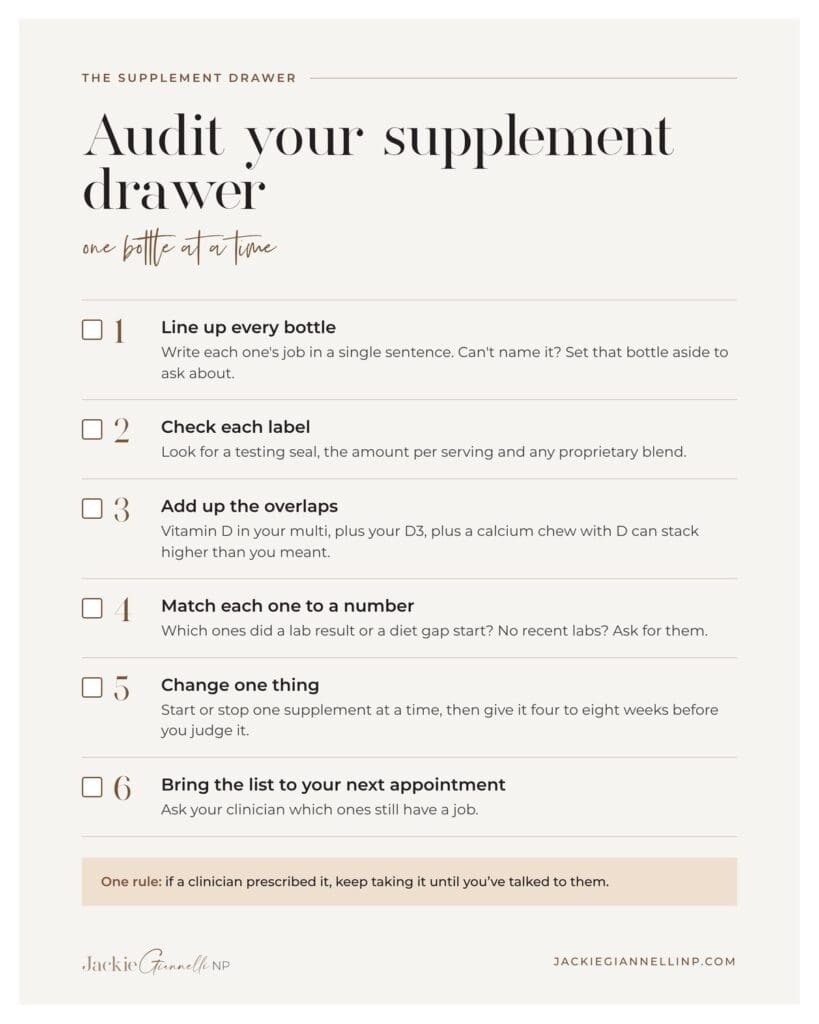
How to audit your supplement drawer this week
- Line up every bottle and write each one’s job in a single sentence. Can’t name it? Set that bottle aside to ask about.
- Check each label for a testing seal, the amount per serving, and any proprietary blend.
- Add up the overlaps. Vitamin D in your multivitamin, plus your D3, plus a calcium chew with D, can stack higher than you meant.
- Match each one to a number. Which ones did a lab result or a diet gap start? If you don’t have recent labs, ask for them.
- Change one thing. Start or stop one supplement at a time, then give it four to eight weeks before you judge it.
- Bring the list to your next appointment, and ask your clinician which ones still have a job.
Build your stack around your own data. The Cool Girl Stack is my free guide to what to test, what to ask, and how to build a stack that fits your body rather than someone’s comment section.
Frequently asked questions
You may not. The U.S. Preventive Services Task Force found the evidence insufficient to say a multivitamin prevents heart disease or cancer. (2) A multivitamin can fill a gap if your diet is limited, but it’s a backup plan, so check what’s in it against what else you take.
The ones a lab result or a diet gap points to, such as vitamin D, iron, B12 or omega-3s. For hot flashes and night sweats, the Menopause Society did not recommend supplements or herbal remedies in its 2023 review. (3) Hormone therapy has the strongest evidence for those symptoms.
Not always. In the 2023 study of 25 melatonin gummy brands, 22 were mislabeled, and the real amount ranged from 74% to 347% of the label. (5) If you prefer gummies, look for a third-party testing seal.
It means an independent organization, such as USP or NSF, tested the product against quality standards and checked how it was made. (6) The seal speaks to quality. Whether the supplement works for you, and whether you need it, are separate questions.
It can be risky. Overlapping products can push vitamins A and D or iron above safe amounts, and some supplements interact with prescriptions such as thyroid medication, blood thinners and birth control. Bring your full list to your clinician.
Give it four to eight weeks, and decide before you start what “working” would look like. Change one thing at a time, so you can tell which bottle did what.
Biotin is the one to ask about. At 10 mg a day, it changed thyroid test results on some lab platforms in a 2021 study. (7) Tell whoever orders your labs everything you take, and ask what to pause and for how long.
Where to start with supplements for women over 40 this week
Pull everything out of the drawer tonight and give each bottle a one-sentence job. That’s how judging supplements for women over 40 starts: a list, a number behind every bottle you keep, and one change at a time.
If you’d like a plan for building it back up from your own data, my free Cool Girl Stack guide walks you through it.
This content is for informational and educational purposes only and is not intended as medical advice. Talk to your healthcare provider before starting or stopping any supplement or medication.
References
- Mishra S, Stierman B, Gahche JJ, Potischman N. Dietary supplement use among adults: United States, 2017–2018. NCHS Data Brief no. 399. Hyattsville, MD: National Center for Health Statistics; 2021. https://doi.org/10.15620/cdc:101131
- US Preventive Services Task Force. Vitamin, mineral, and multivitamin supplementation to prevent cardiovascular disease and cancer: US Preventive Services Task Force recommendation statement. JAMA. 2022. https://doi.org/10.1001/jama.2022.8970
- The 2023 nonhormone therapy position statement of The North American Menopause Society. Menopause. 2023;30(6):573-590. https://pubmed.ncbi.nlm.nih.gov/37252752/ https://doi.org/10.1097/GME.0000000000002200
- Crawford C, Avula B, Lindsey AT, et al. Analysis of select dietary supplement products marketed to support or boost the immune system. JAMA Network Open. 2022;5(8):e2226040. https://pmc.ncbi.nlm.nih.gov/articles/PMC9366544
- Cohen PA, Avula B, Wang YH, Katragunta K, Khan I. Quantity of melatonin and CBD in melatonin gummies sold in the US. JAMA. 2023;329(16):1401-1402. https://pmc.ncbi.nlm.nih.gov/articles/PMC10130950/
- United States Pharmacopeia. Dietary Supplements Verification Program. https://www.usp.org/verification-services/dietary-supplements-verification-program
- Ylli D, Soldin SJ, Stolze B, et al. Biotin interference in assays for thyroid hormones, thyrotropin and thyroglobulin. Thyroid. 2021;31(8):1160-1170. https://pmc.ncbi.nlm.nih.gov/articles/PMC8420951/
- American Society of Hematology. ASH sets new standards for diagnosing iron deficiency. Press release, Sept 16, 2026. https://www.hematology.org/news-and-media/press-releases/2026/ash-sets-new-standards-for-diagnosing-iron-deficiency
- Bolland MJ, Avenell A, Baron JA, et al. Effect of calcium supplements on risk of myocardial infarction and cardiovascular events: meta-analysis. BMJ. 2010;341:c3691. https://doi.org/10.1136/bmj.c3691


