


Medically reviewed by Jackie Giannelli, FNP-BC, MSCP
You already know what GLP-1s do. The harder question is how one plays out in a body that’s also in perimenopause, when estrogen is falling, muscle is already slipping, and your hair is more fragile than it used to be. Here’s who I think these drugs are for in this stage, what they can do beyond the scale, and how to protect your muscle and your hair if you start one.
On a GLP-1 and finding more hair in the shower drain? My Hair Longevity Blueprint walks you through how to support your hair before it gets worse. Get the Hair Longevity Blueprint.
What exactly is a GLP-1?
GLP-1 stands for glucagon-like peptide-1, a hormone your gut releases after you eat. GLP-1 drugs mimic that hormone, and they last much longer in your body than the “natural” version your gut makes.
Semaglutide (sold as Ozempic and Wegovy) and tirzepatide (Mounjaro and Zepbound) slow how fast your stomach empties, turn down hunger signals in the brain, and help your body release insulin when blood sugar rises.
In the STEP 1 trial, a large GLP-1 study published in the New England Journal of Medicine, adults on semaglutide lost close to 15% of their body weight over 68 weeks, compared with 2.4% on placebo. (1)
Which is a significant amount of weight. For many women, this is enough to improve insulin resistance and cardiometabolic markers. And that’s why clinicians are so excited about these drugs.
Should I take a GLP-1 in perimenopause?
A GLP-1 can make sense in perimenopause if you meet the medical criteria for one and you’re prepared to protect your muscle while you take it.
Now, obviously, a GLP-1 doesn’t treat perimenopause itself. No GLP-1 is approved for hot flashes, sleep, or mood, so it won’t stand in for hormone therapy for those symptoms. But they can be very valuable tools for the insulin resistance, visceral fat, and inflammation levels that tend to rise for many women in perimenopause and menopause.
I’ve used a microdosed GLP-1 myself, alongside hormone therapy, changes to how I eat, and firmer limits on my time and alcohol. Together they’ve helped keep me metabolically steady through some very demanding years.
Why is my blood sugar harder to control in perimenopause?
Two things change at once in perimenopause. Estrogen helps your muscles and liver respond to insulin, so as it falls and swings, the same amount of insulin does less work. (2) At the same time, more fat settles around your middle and around your organs. That deeper belly fat is closely tied to insulin resistance, which means your body needs more insulin to move the same amount of sugar out of your blood.
The Study of Women’s Health Across the Nation (SWAN), a long-running American project that has followed thousands of women through menopause, measured this with body scans.
The scans showed that at the start of the transition, the rate of fat gain doubled and lean mass started to decline. Weight on the scale kept climbing at a steady pace. (3) Your muscles soak up most of the sugar from a meal, so as you lose muscle, more of that sugar stays in your blood.
A separate SWAN analysis found that visceral fat, the fat packed around your organs, rises with menopause and independently predicts metabolic syndrome, diabetes, and heart disease in women. (4)
SWAN researchers have also linked hot flashes to higher insulin resistance over eight years of follow-up. (5)
Day to day, insulin resistance in menopause can show up as weight gain, feeling tired after a carb-heavy meal, or a fasting glucose that creeps up a few points at each physical. If any of that sounds familiar, ask your doctor for an A1C, fasting glucose, fasting insulin, and a full lipid panel with ApoB (a closer read on heart risk) to get the lay of the land and fully understand if a GLP-1 is the right tool for you.
So, who are GLP-1 drugs actually for?
GLP-1 drugs for weight are approved for adults with obesity, or adults with overweight plus at least one weight-related condition, such as high blood pressure, prediabetes, or high cholesterol.
In the STEP 1 GLP-1 trial, that meant a BMI of 30 or higher, or 27 or higher with a related condition. (1) By brand, Ozempic and Mounjaro are approved for type 2 diabetes. Wegovy and Zepbound are approved for weight management.
In my view, ten pounds that settled around your middle in perimenopause, with normal blood sugar and no other risk factors, is a strength-training and protein problem first. But, if you can’t get the weight to budge no matter what you do, taking small “micro” doses of GLP-1s can be a useful tool to address the stubborn, hormonally-driven weight that often accumulates during perimenopause and menopause, with less risk of overshooting your goal.
A GLP-1 in perimenopause makes even more sense once the weight has started to cost you something medically.
Here’s the thing about GLP-1s. We’re still understanding the ways they affect the body. But weight is only one reason I’d consider a GLP-1.
These drugs help your body use insulin better and can lower inflammation, so I also think about them for women with PMOS (the condition formerly called PCOS), a high Lp(a) or a strong family history of heart disease, or a family history of Alzheimer’s. The research is early, but it’s enough to make a lot of practitioners cautiously optimistic.
The heart evidence is pretty compelling. In a large trial, people with excess weight and existing heart disease had fewer heart attacks and strokes on semaglutide. (6)
GLP-1 warnings
Some situations call for a careful conversation before you start taking any GLP-1:
- A personal or family history of medullary thyroid cancer or MEN 2. The Wegovy and Zepbound labels list these as reasons not to use the drugs. (7, 8)
- Any chance of pregnancy. You can still conceive in perimenopause. The Wegovy label advises stopping at least two months before a planned pregnancy. (7)
- Birth control. Tirzepatide can make oral contraceptives less reliable. The Zepbound label advises switching to a non-oral method, or adding a barrier method, for four weeks after starting and after each dose increase. (8)
- A past bout of pancreatitis, gallbladder trouble, or a history of disordered eating. None of these is automatically a no. But they require extra planning.
Does hormone therapy make a GLP-1 work better?
Hormone therapy may add a modest boost to GLP-1 weight loss, but the research is still emerging.
The first study on this came from Mayo Clinic in 2024. Researchers there looked back at 106 postmenopausal women on semaglutide. The 16 women also on hormone therapy lost about 16% of their body weight at one year, versus 12% for the 90 women who weren’t. (9) Sixteen women is a small group, but it hints at a link.
In October 2026, a Mayo Clinic team presented a much larger look at the same question at the Menopause Society’s annual meeting, using health records from about 3,900 women. On semaglutide, women using hormone therapy had lost 11.9% of their body weight at final follow-up, versus 10.9% for nonusers. The pattern was weaker with tirzepatide. (10) Those results haven’t been published in a peer-reviewed journal yet.
A one-point difference is small. I start my patients on hormone therapy for hot flashes, night sweats, sleep, and bone protection. If it happens to help your GLP-1 along, that’s just a bonus.
How do I keep from losing muscle on a GLP-1?
One of the big fears when midlife women go on GLP-1s is that the weight loss they induce is typically accompanied by muscle loss. Which is something you can’t afford in midlife.
In a body-scan substudy of the STEP 1 trial, semaglutide users lost 19.3% of their fat mass, and their lean mass fell 9.7% from where it started. (11) Their body composition improved overall, because they lost fat faster. But that lean tissue is the same muscle the SWAN body scans show starting to slip at the menopause transition. (3) On a GLP-1 in perimenopause, you’re dealing with both issues at once.
So, you’ve got to work proactively and protect muscle on a GLP-1 with three habits:
- Eat enough protein
- Lift weights
- Track body composition instead of the scale alone
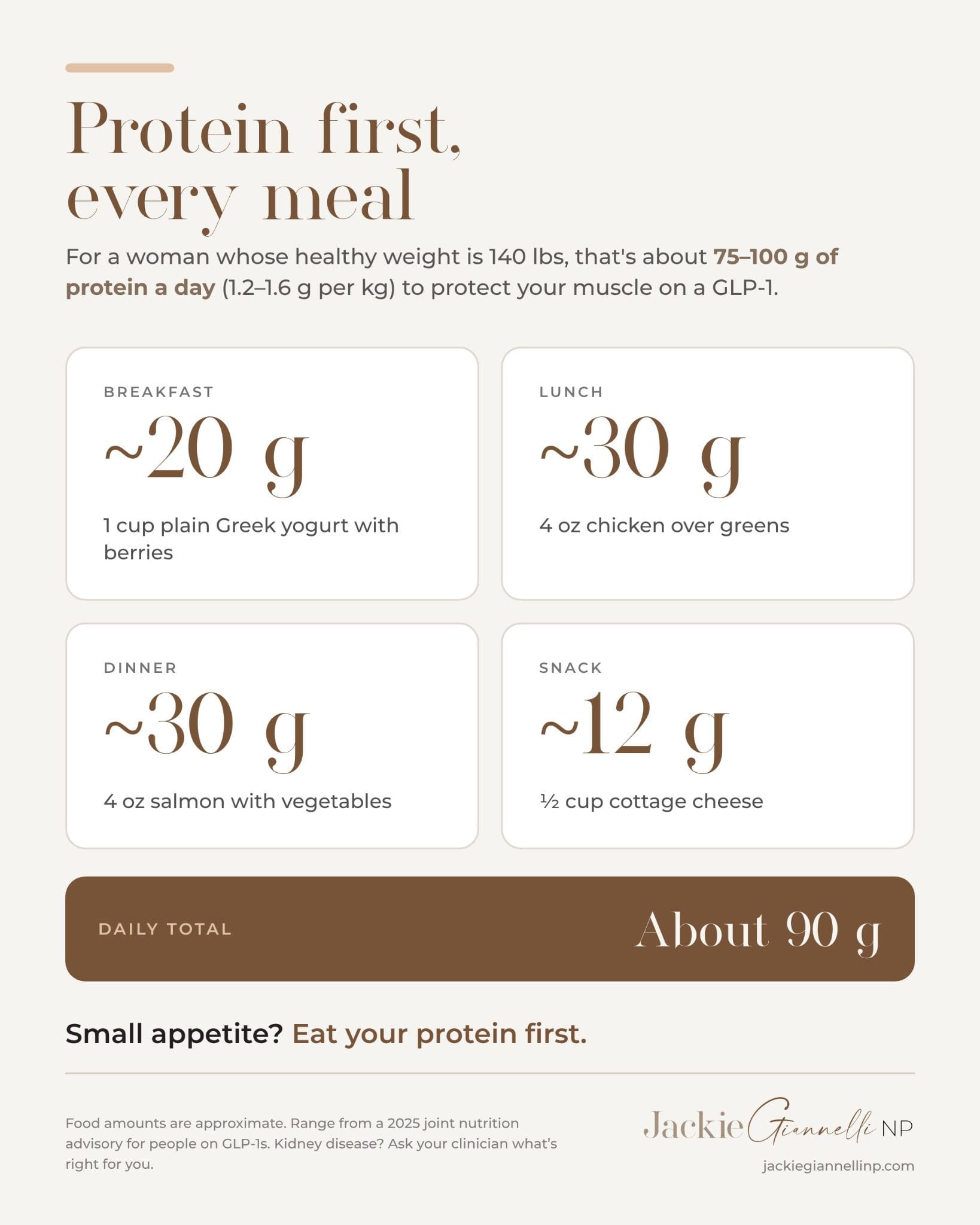
In 2025, four groups, including the American Society for Nutrition and the Obesity Medicine Association, published joint advice for people on GLP-1s. They recommended 1.2 to 1.6 grams of protein per kilogram of healthy body weight a day. (12) For a woman whose healthy weight is about 140 pounds, that’s roughly 75 to 100 grams a day. Eat the protein first at every meal, before the drug tells you you’re full.
Then, lift, and lift heavy. I covered the weightlifting strategy that builds muscle and bone in sarcopenia and exercise after 40. But, on a GLP-1, training is what keeps the weight you lose mostly fat.
Finally, get a baseline. A DEXA scan or a similar body composition test before you start, and again later, tells you what the scale can’t. I treat it as one marker among several, but it’s the one that can show whether you’re keeping your muscle or not.
Why is my hair falling out on a GLP-1?
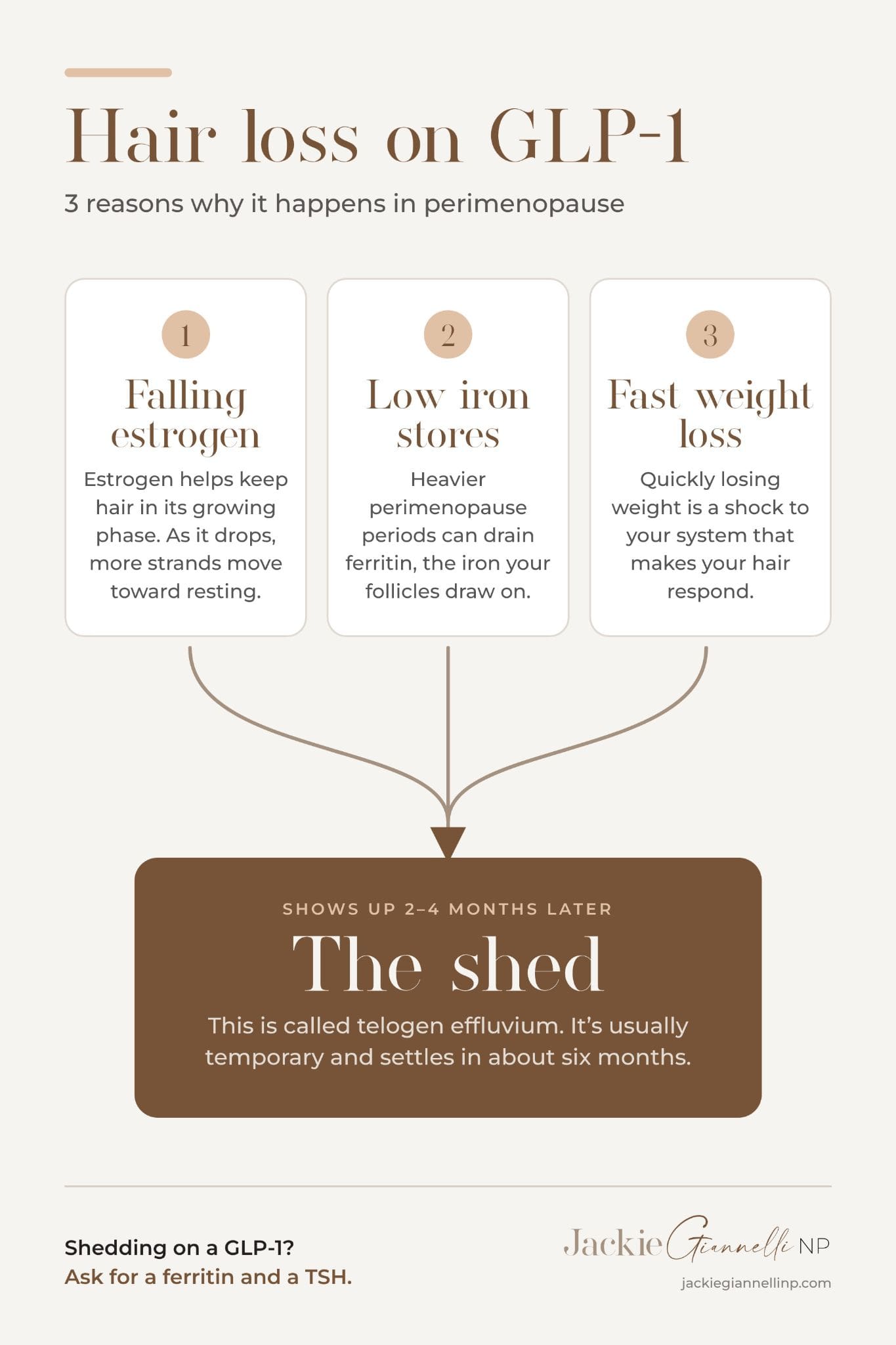
Hair loss on a GLP-1 is most often telogen effluvium, a temporary shed that shows up two to four months after rapid weight loss or another shock to the body. It usually settles on its own. On a GLP-1 in perimenopause, though, shedding rarely has just one cause.
The Wegovy label reports hair loss in 4% of women on the standard weight-loss dose, compared with 2% of women on placebo. At the newer, higher dose, 8.4% of women reported it. The label ties hair loss to weight reduction. (7)
Harvard Health lists extreme weight loss, abrupt hormonal changes including menopause, iron deficiency and thyroid problems among the triggers of telogen effluvium. (13) In perimenopause, you can be dealing with three of those triggers at once: falling estrogen, iron stores drained by heavier periods, and fast weight loss from the drug. Add a smaller appetite that cuts your protein, and your hair has very little to work with.
So I don’t wave this off as “it’ll grow back.” If you’re shedding on a GLP-1, ask for a ferritin level (your iron stores) and a TSH (your thyroid screen). Round bald patches, lost eyebrows, or a sore, scaly scalp point to something else, so see a dermatologist for those.
More hair in the drain than you’d like? My Hair Longevity Blueprint is the step-by-step plan I use for midlife shedding: hormones, iron, gut health, and red light therapy, in the order I’d look at them, with a month-by-month roadmap and the questions to bring to your clinician. Get the Hair Longevity Blueprint →
What happens when you stop a GLP-1?
Most people regain a large share of the weight within a year of stopping a GLP-1. In the STEP 1 trial extension, people who stopped semaglutide after 68 weeks regained about two-thirds of the weight they’d lost by one year later. Their blood pressure and blood sugar improvements drifted back toward where they started, too. (14)
Some women stay on a GLP-1 long term, the way they’d stay on a blood pressure medication. Others plan to come off once they’ve built new habits.
What should I ask before starting a GLP-1 in perimenopause?
Bring these six questions to your appointment. For how I’d frame the conversation, and the safest ways to get a prescription, read my full breakdown in my newsletter here.
- “Can we check my A1C, fasting insulin, a full lipid panel with ApoB, inflammatory markers, ferritin, and TSH first?” You want a baseline for blood sugar, heart risk, inflammation, iron, and thyroid before anything changes.
- “Can I get a body composition baseline?” A DEXA or a similar scan shows fat and muscle separately.
- “What’s my protein and strength plan?” If the answer is “eat less,” ask again.
- “How does this fit with hormone therapy?” If you have hot flashes, poor sleep, or bone concerns, that conversation stands on its own.
- “What about birth control?” You can still get pregnant in perimenopause, and tirzepatide can affect the pill.
- “What’s the plan if I stop?” Ask it on day one.
A GLP-1 in perimenopause works best when your labs, your protein, and your strength training are lined up before the first dose.
Frequently asked questions
For most women, the stomach side effects of a GLP-1, like nausea, fullness and constipation, are worst in the first weeks and again after each dose increase, then ease. Hair shedding runs on a different clock. It tends to show up two to four months after fast weight loss and usually settles within about six months. Tell your prescriber about anything that isn’t easing.
No GLP-1 is approved to treat hot flashes or night sweats. Some women feel better overall as their weight and blood sugar improve, but for hot flashes themselves, hormone therapy and approved non-hormonal options have far stronger evidence.
Yes, many women do, and Mayo Clinic studies suggest women on both may lose a little more weight than women on a GLP-1 alone. The extra loss in the largest study so far was about one percentage point. Start hormone therapy for your symptoms, not for the scale.
Some change is common, but the bigger shift is where weight goes. In the SWAN study, weight on the scale kept rising at the same steady pace through the menopause transition, while fat gain sped up and muscle started to decline. Your scale may look the same while your waistline and blood sugar don’t.
A 2025 joint advisory from four obesity and nutrition organizations recommends 1.2 to 1.6 grams of protein per kilogram of healthy body weight a day. For a healthy weight of about 140 pounds, that’s roughly 75 to 100 grams. Eat it first at each meal, while you still have room.
Shedding from fast weight loss is usually temporary, and hair tends to recover once your weight steadies and any gaps, like low iron, are fixed. Patchy bald spots, lost eyebrows or a sore, scaly scalp suggest a different cause, so see a dermatologist for those.
Not necessarily, but plan for what happens if you stop. In the STEP 1 trial extension, people regained about two-thirds of the weight they’d lost within a year of stopping semaglutide. Building muscle while you’re on it gives you more to keep.
This article is for informational and educational purposes only and is not a substitute for professional medical advice. Talk with your own clinician before starting, stopping or changing any medication.
Ready to get your hair back on your side?
If a GLP-1, perimenopause, or both have you counting strands in the drain, my Hair Longevity Blueprint gives you the plan I use with midlife women: what to check, in what order, and what to bring to your next appointment. Get the Hair Longevity Blueprint.
References
- Wilding JPH, Batterham RL, Calanna S, et al. Once-weekly semaglutide in adults with overweight or obesity (STEP 1). N Engl J Med. 2021;384:989-1002. https://doi.org/10.1056/NEJMoa2032183
- Mauvais-Jarvis F, Manson JE, Stevenson JC, Fonseca VA. Menopausal hormone therapy and type 2 diabetes prevention: evidence, mechanisms, and clinical implications. Endocrine Reviews 2017;38(3):173-188. https://doi.org/10.1210/er.2016-1146
- Greendale GA, Sternfeld B, Huang M, et al. Changes in body composition and weight during the menopause transition. JCI Insight. 2019;4(5):e124865. https://doi.org/10.1172/jci.insight.124865
- Janssen I, Powell LH, Kazlauskaite R, Dugan SA. Testosterone and visceral fat in midlife women: the SWAN Fat Patterning Study. Obesity. 2010;18(3):604-610. https://pmc.ncbi.nlm.nih.gov/articles/PMC2866448/
- Thurston RC, El Khoudary SR, Sutton-Tyrrell K, et al. Vasomotor symptoms and insulin resistance in the Study of Women’s Health Across the Nation. J Clin Endocrinol Metab. 2012;97(10):3487-3494. https://pmc.ncbi.nlm.nih.gov/articles/PMC3462945/
- Lincoff AM, Brown-Frandsen K, Colhoun HM, et al. Semaglutide and cardiovascular outcomes in obesity without diabetes (SELECT). N Engl J Med. 2023;389(24):2221-2232. https://doi.org/10.1056/NEJMoa2307563
- Novo Nordisk. WEGOVY (semaglutide) prescribing information, revised 2026 U.S. Food and Drug Administration. https://www.accessdata.fda.gov/drugsatfda_docs/label/2026/215256s029lbl.pdf
- Eli Lilly and Company. ZEPBOUND (tirzepatide) prescribing information, updated August 2026 (contraindications; oral contraceptives). DailyMed. https://dailymed.nlm.nih.gov/dailymed/drugInfo.cfm?setid=487cd7e7-434c-4925-99fa-aa80b1cc776b
- Hurtado MD, Tama E, Fansa S, et al. Weight loss response to semaglutide in postmenopausal women with and without hormone therapy use. Menopause. 2024;31(4):266-274. https://doi.org/10.1097/GME.0000000000002310
- Castaneda R, et al. Menopause hormone therapy and weight loss with semaglutide and tirzepatide in midlife women. Presented at The Menopause Society 2026 Annual Meeting, San Diego, October 2026. https://www.patientcareonline.com/view/menopause-hormone-therapy-linked-to-greater-weight-loss-with-semaglutide-in-real-world-study
- Wilding JPH, Batterham RL, Calanna S, et al. Impact of semaglutide on body composition in adults with overweight or obesity: exploratory analysis of the STEP 1 study. J Endocr Soc. 2021;5(Suppl 1):A16-A17. https://pmc.ncbi.nlm.nih.gov/articles/PMC8089287/
- Mozaffarian D, Agarwal M, Aggarwal M, et al. Nutritional priorities to support GLP-1 therapy for obesity: a joint Advisory from the American College of Lifestyle Medicine, the American Society for Nutrition, the Obesity Medicine Association, and The Obesity Society. Am J Clin Nutr. 2025;122(1):344-367. https://pubmed.ncbi.nlm.nih.gov/40450457/
- Harvard Health Publishing. Telogen effluvium. Harvard Medical School. https://www.health.harvard.edu/a-to-z/telogen-effluvium-a-to-z
- Wilding JPH, Batterham RL, Davies M, et al. Weight regain and cardiometabolic effects after withdrawal of semaglutide: the STEP 1 trial extension. Diabetes Obes Metab. 2022;24(8):1553-1564. https://doi.org/10.1111/dom.14725


