


Medically reviewed by Jackie Giannelli, FNP-BC, MSCP.
You are falling asleep on the couch at 8:30 and still dragging at 10 a.m. So can low estrogen cause fatigue, and how would you actually know? Yes, it can. Here is the physiology behind it, and the specific tests I would want you walking in and asking for.
I am a nurse practitioner who treats midlife women, and this is the single most common conversation I have.
I put the lab markers I actually want on a woman over 35, and what each one is telling you, into a free guide. Grab the Lab Guide here. It is the thing I wish every woman walked into her appointment holding.
Can low estrogen cause fatigue? Yes, and it is the most reported symptom of the lot
In a survey of more than 12,000 women aged 35 and over, published in Menopause, the journal of The Menopause Society, fatigue was the most commonly reported symptom at 83 percent, tied with physical and mental exhaustion, and ahead of irritability, low mood, sleep problems, and anxiety. (1)
Sit with the ranking for a second. Not hot flashes. Fatigue.
In the same survey, 71 percent of women recognized hot flashes as a perimenopause symptom. So the symptom women are taught to expect, and the symptom women actually report, are two different things. Worth knowing, because it means fatigue is a reasonable thing to bring up as a hormonal question with your doctor.
Now, that was a survey of app users, not a population sample, so 83 percent almost certainly runs high. But still, the ranking is what tells us fatigue is a very common menopause symptom.
Why your bloodwork came back normal
We hear this complaint a lot in women’s health. That you got up the nerve to ask for bloodwork, and it all came back “within normal range.” Here’s why that actually happens.
Estradiol is the last marker to change
Here is the thing about perimenopause. Estradiol does not slope politely downward from 42 onward. In the early menopause transition, it can be normal or even frankly elevated, and it is the last biomarker of the transition to change, with a rapid decline beginning roughly two years before your final period. (2)
So a 46-year-old can have textbook perimenopausal symptoms and a mid-normal estradiol on the same morning. The lab is right. But she is also right to suspect her hormones are causing her issues.
What drives symptoms in the early transition is volatility, not a floor value. Your body is responding to the wild roller coaster ride of hormonal fluctuations.
One draw is a snapshot of a moving target
During the transition, hormone levels vary so markedly that single measurements of FSH or estradiol are unreliable guides to menopausal status. In one Australian study that followed the same women year after year through the transition, one woman’s FSH could land at normal reproductive-age levels, intermediately elevated levels, or postmenopausal levels depending purely on the day the sample was drawn. (3)
So when your panel came back “normal,” what you learned was what your estradiol was doing between 8:15 and 8:20 on a Tuesday in March. That is genuinely all.
Perimenopause is staged by your cycle, not your hormone panel
The UK’s national clinical guideline is unusually blunt about this. It tells clinicians to diagnose perimenopause in women aged 45 and over on symptoms and menstrual-cycle changes without laboratory tests, and it names estradiol, AMH, inhibin A and B, antral follicle count and ovarian volume in a numbered recommendation of tests not to use for diagnosing menopause. FSH is reserved for women aged 40 to 45 with symptoms, or under 40 with suspected premature ovarian insufficiency, and it is invalid altogether in women on combined hormonal contraception or high-dose progestogen. (4) That last line matters more than it sounds, because a lot of women in their forties are on exactly those.
The international staging system clinicians use, STRAW+10, works the same way: menstrual bleeding criteria are the principal criteria, and endocrine measures are supportive, not diagnostic. (5)
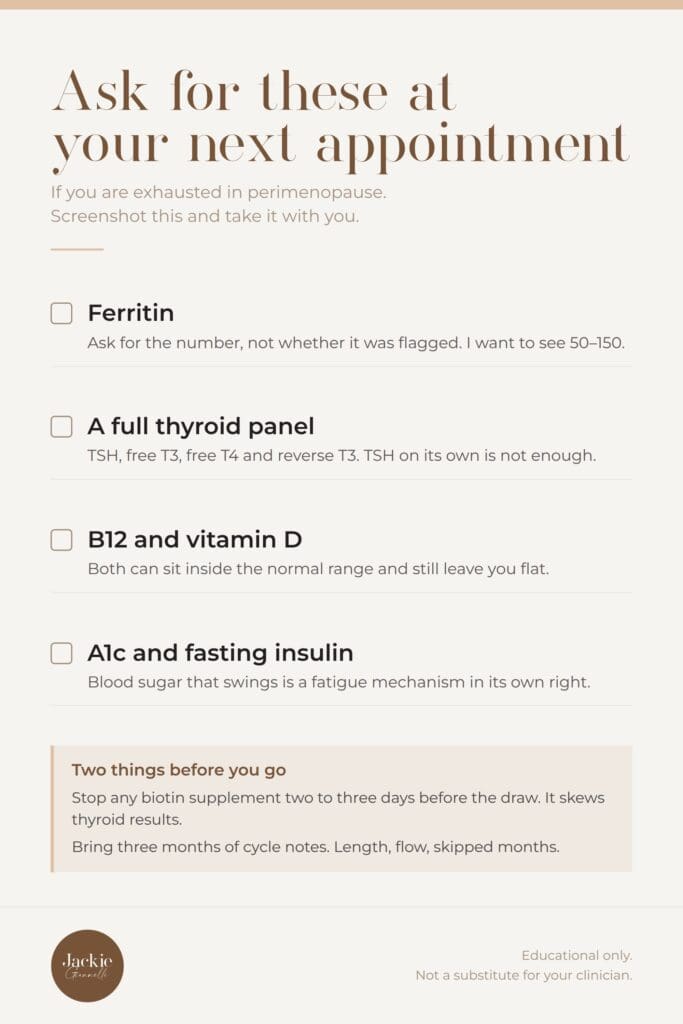
Which means the most useful thing you can bring to an appointment is not another test result. It is your cycle history: the length, the flow, the skipped months. That is the actual diagnostic instrument here, and you are the only person who can collect it.
What low estrogen fatigue is actually doing in your body
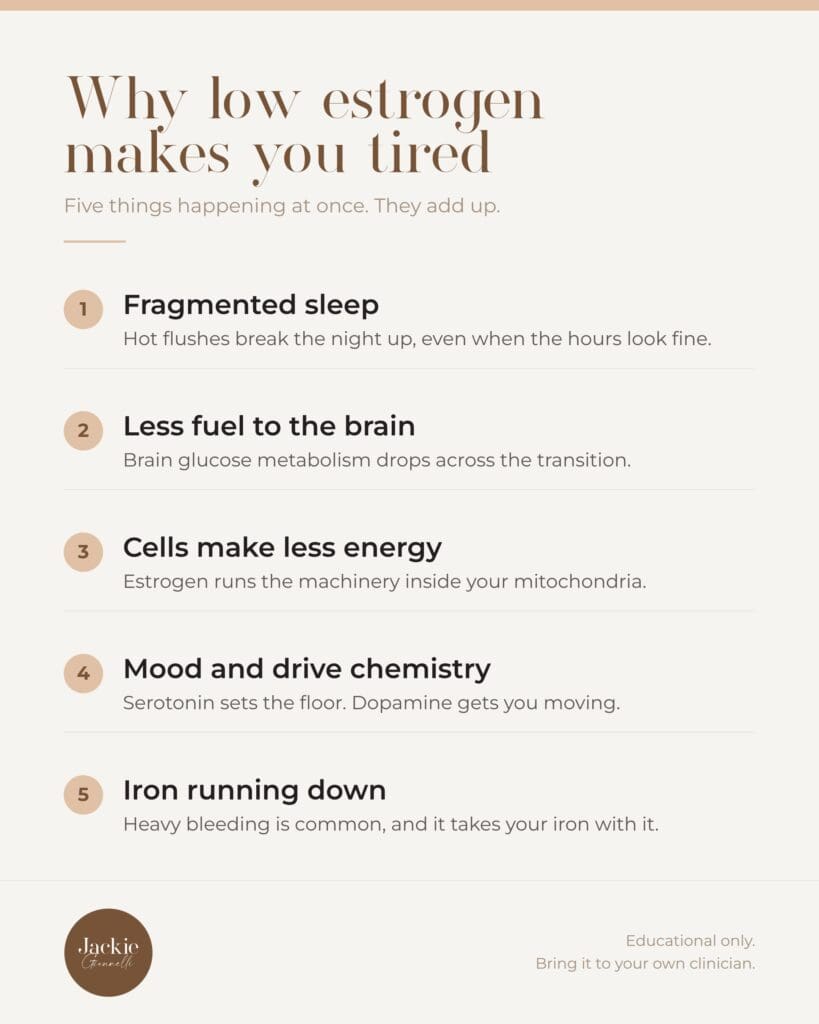
Sleep that fragments while you are still in bed
Estrogen withdrawal narrows the thermoneutral zone, the temperature band your body is comfortable in.
Narrow that band, and you get vasomotor symptoms, and those produce abrupt sympathetic activation and cortical arousals that interrupt both NREM and REM sleep. Postmenopausal women also show more light-stage sleep with elevated beta power during NREM, a pattern consistent with physiological hyperarousal. (6)
Translation: you can be horizontal for eight hours and get five hours’ worth of restoration, and the sleep tracker will not necessarily tell you, because total time in bed looks fine.
But here is the piece I find most compelling, and it is why I stopped treating this as purely a sleep problem. In a controlled crossover study, researchers suppressed estradiol pharmacologically in premenopausal women and separately fragmented their sleep, keeping total sleep time constant. Fragmentation increased daytime sleepiness by about the equivalent of one to two hours of lost sleep.
And estradiol suppression on its own slowed reaction time by 12.3 milliseconds, independent of any sleep effect. (7)
That is causal, experimental evidence that estrogen is doing something to daytime function that is not downstream of bad sleep. It was a small study, only twenty women, but I still think it is the most important paper in this whole conversation.
A brain running on less fuel
Estrogen is a master regulator of how the brain makes energy. It upregulates the glucose transporters that move fuel across the blood-brain barrier and into neurons, and it coordinates aerobic glycolysis, the TCA cycle, and ATP synthesis. (10)
When it declines, that shows up on imaging. In a study using FDG-PET (a brain scan that measures how much fuel the brain is burning) in cognitively normal women aged 40 to 60, perimenopausal women showed roughly an 8 percent reduction in brain glucose metabolism compared with premenopausal women, and postmenopausal women roughly 19 percent. (8)
A larger follow-up in 161 women, with a male comparison group and a longitudinal subset, found the same pattern of reduced brain glucose metabolism alongside changes in brain structure, connectivity, and amyloid-beta. (9)
Just to be clear, those studies measured brain energetics. They did not necessarily measure fatigue. The link between the two is mechanistic inference, and anyone telling you otherwise is selling something.
What I will say is that the perimenopausal group already showed changes in their brain activity, which is exactly what I’m saying here: symptoms often start well before your estrogen is officially low.
The power plants of your cells are running on fumes
Maybe you remember from high school that every cell in your body makes energy in the mitochondria. There are thousands of them per cell, each one running a small assembly line that turns fuel into something your body can spend, with one particular enzyme doing the final step.
Estrogen is one of the signals that runs that line. It tells cells to build more mitochondria, and it turns up production of that final enzyme. Estrogen receptors sit inside the mitochondria themselves, which is not where anyone expected to find them. (10)
So what happens to the assembly line when the signal gets noisy?
In 2017, a research team measured exactly that. Alongside the brain scans, they took blood from the same 43 women and measured how active that final enzyme was. Compared with women who had not yet started the transition, activity ran about 30 percent lower in the perimenopausal group and about 57 percent lower after menopause. It moved in step with the brain scans and with how the women scored on memory testing. (8)
Here is why I think that matters to you specifically.
Tiredness from short sleep is a debt. You pay it back, and it lifts. What most women describe to me is a different animal: you sleep, and it does not restore you. Reduced energy production is one of the few explanations that actually fits that pattern, because it is a supply problem rather than a debt.
Now here’s the fine print…
They measured this in platelets, which come out of an ordinary blood draw and get used as a stand-in for what cells elsewhere are doing. Nobody put a needle in anyone’s thigh. It was a small study. And the underlying work on estrogen and mitochondria is mostly done in cells and animals rather than in women.
And this is a research assay, not a test on any lab menu. You cannot go and order it.
Serotonin, dopamine, and the flat feeling
Estrogen has a hand in both ends of your serotonin supply. It turns up the enzyme that builds serotonin, and it turns down the enzyme that clears it away. More getting made, less getting taken apart.
It does something similar for dopamine, which is the chemistry behind wanting things. Estrogen increases how much of it gets released, and that effect has shown up in females and not in males. (11)
Serotonin sets the floor of your mood. Dopamine is what gets you off the sofa. When estrogen starts swinging, neither one is as steady as it was.
Most of that work has been done in cells and animals rather than in women, so we’ll treat it as the mechanism rather than the proof. But it maps onto something my patients describe constantly and rarely have a word for: not sadness exactly, more that the thing that used to make them get up and go has gone flat. This can be conflated with fatigue, because they both basically feel the same.
The iron your heavy periods are taking with them
The Study of Women’s Health Across the Nation (SWAN) is a long-running American research project that has followed thousands of women across different racial and ethnic backgrounds, all the way through the menopause transition.
Its data showed 34.5 percent of women had three or more episodes of heavy bleeding lasting three days or longer. (13)
And in a 2025 analysis of the same study, published in Menopause and following 2,329 women, three or more heavy bleeding episodes in six months was associated with increased odds of feeling tired, and three or more prolonged episodes with reduced odds of feeling “full of pep.” (12) Now, the authors did not measure iron, and they say so, but iron depletion is the likely reason for the women feeling low energy.
Most US labs flag ferritin as normal down to about 15 to 20 ng/mL. But in a double-blind placebo-controlled trial of 198 non-anemic menstruating women with ferritin under 50 mg/L, twelve weeks of oral iron reduced fatigue by 47.7 percent versus 28.8 percent on placebo. (14)
Send me the FREE Lab Guide · All the markers I like to see in women over 35
The thyroid overlap that muddies everything
Thyroid is usually the first thing tested when a woman reports exhaustion, and it should be. But thyroid disease and the menopause transition look so alike that the European Menopause and Andropause Society said plainly in 2024 that without specific signs, it is difficult to tell which one you are looking at. Both can cause irregular periods, mood changes, lower libido, more sweating, disrupted sleep, and hair loss.
Plus, sometimes a thyroid is underactive enough to show as a single out-of-range number on a blood test while everything else still reads normal, and while you feel nothing specific enough to mention. We call this “subclinical.”
Somewhere between 6 and 10 percent of women in their reproductive years (perimenopause included) have subclinical hypothyroidism. So it’s common enough, and similar enough to perimenopause, that it is worth ruling out rather than assuming. (15)
Important thyroid-related notes:
- Stop biotin supplements before a thyroid draw. Biotin can produce false TSH, free T3, free T4 and total T4 results on the immunoassays most labs run. EMAS advises stopping biotin-containing supplements two to three days before testing. (15) So if you’re taking any hair, skin, and nail supplements, be sure to check the label and stop them before testing.
- Oral estrogen changes your thyroid medication dose. Oral estradiol raises thyroxine-binding globulin, which can raise levothyroxine requirements in women who are hypothyroid. (19) However, transdermal estradiol does not affect thyroid function. (15) So if you are on thyroid replacement and you start oral hormone therapy, your thyroid labs need rechecking. But the estrogen patch sidesteps the issue entirely.
The labs I would actually want, and how I would read them
The leading US primary-care guidance on evaluating fatigue in adults recommends CBC, ferritin, iron panel, folate, B12, TSH, A1C, and a basic metabolic panel as initial testing, and it explicitly cautions that untargeted testing is low yield and changes treatment in only about 5 percent of patients. (16) It also, and I checked this line by line, does not mention the menopause transition anywhere in its differential.
I raise that because it tells you where to put your effort. The panel itself is a good panel. What makes it useful for you is the history it gets drawn against, and that is the part you can supply.
So: history first, and it has to include your cycle length, your flow, whether you are soaking through protection, whether you are skipping months, and whether you are having night sweats. Then labs.
The one number I want you to go and find
Ferritin. Not whether it got flagged. The number.
I want to see it between 50 and 150. Most US labs will call it normal down the whole way to about 15, which is exactly why this one slips past. And there is good evidence behind the higher floor: the CMAJ trial in non-anemic menstruating women used ferritin under 50 as its entry threshold. (14)
So if yours came back at 22 and nobody mentioned it, that is worth a conversation. It is the cheapest and most fixable thing on this entire page, and you may already have the number sitting in a portal.
The rest of what I would run, and why each one is on the list
A full thyroid panel. TSH, free T3, free T4, and reverse T3. TSH on its own is not enough, because it tells you what your brain is asking the thyroid for rather than what your body is actually getting.
B12 and vitamin D. Both of these can sit inside the normal range and still leave you flat.
A1c and fasting insulin. Blood sugar that swings is common in midlife and is a fatigue mechanism in its own right.
Estradiol and FSH, with your expectations set. Over 45, these will not diagnose anything, and the UK’s national clinical guideline names estradiol specifically as a test not to use for that purpose. (4) They tell you roughly where you are standing. They do not tell you whether you are in the transition.
What I would skip
Saliva and urine hormone panels for this question. At-home one-off estradiol tests, which have exactly the problem this whole post is about.
Where the actual numbers live
This list is the fatigue-specific slice. The full picture is wider: heart and metabolic markers, inflammation, the complete hormone panel, nutrient status.
I put all of it, with my optimal range for every single marker, in my free Lab Guide. Not the lab’s normal range. The number I actually want to see.
That distinction is the whole game. Standard reference ranges are population averages. They tell you whether you are unusual. They do not tell you whether you are well.
What to do while you are sorting this out
Testing can take time. Here is what is worth doing meanwhile, in the order I would do it.
- Track your cycle for three months. Length, flow, skipped months, and whether the heavy ones cluster. This is the actual diagnostic instrument, and it is free. You will walk into your next appointment with the data that matters most.
- Protect the sleep window you can control. Cool room, warm and low light after dinner, and the things I lay out in the perimenopause bedroom rules.
- Strength train. Getting plenty of hard exercise during the day tends to help you sleep better at night, and this is the single most important thing you can do right now to protect your bones and your brain, so there are multiple reasons to start or maintain your resistance training. The easiest place to start: wear a weighted vest like this one I love while you’re doing chores or walking. Use code JACKIE15 to save 15% (the best part: it comes with a free DEXA scan!) This is an affiliate link, which may earn me a small commission if you purchase. I completely love this vest and used it myself before becoming an affiliate!
- Ask about hormone therapy with clear eyes. A meta-analysis of seven randomized trials in more than 15,000 women found menopausal hormone therapy modestly improved sleep quality, with the benefit concentrated in women who have vasomotor symptoms and no detectable benefit in women without them. (17) That is a real effect but a limited one.
What answering “can low estrogen cause fatigue” will not do
Naming the mechanism does not exempt you from the boring stuff. Sleep apnea is underdiagnosed in midlife women and gets missed constantly because the textbook patient is a heavier man who snores. Depression is real and treatable and overlaps heavily here. So are anemia, thyroid disease, and a dozen other things worth ruling out.
Low estrogen belongs on the list. But it is not the whole list.
Get the free Lab Guide and walk in with the markers already in hand. And if you want the research, the swaps, and all the clinical reasoning weekly, In the Saddle is my free newsletter and goes out once a week.
This post is for informational and educational purposes only and is not medical advice. It is not intended to diagnose, treat, cure, or prevent any disease. Talk to your own healthcare provider about your situation.
Frequently Asked Questions
Yes. In the early menopause transition, estradiol can be normal or elevated, and it is the last biomarker to change, with a rapid decline beginning about two years before the final period. Levels also vary enough day to day that single measurements are unreliable guides to menopausal status. A normal estradiol on one morning does not rule out estrogen-related fatigue.
Commonly reported signs of low estrogen and of the menopause transition include hot flashes and night sweats, sleep that fragments, irritability and low mood, brain fog, vaginal dryness, joint aches, changes in libido, and cycle changes such as shorter, longer, heavier or skipped periods. Fatigue and exhaustion were the most reported symptoms in a survey of more than 12,000 women aged 35 and over.
Several mechanisms stack. Estrogen withdrawal narrows the thermoneutral zone and drives vasomotor symptoms that fragment sleep. Estradiol suppression alone slows daytime neurobehavioral performance independent of sleep. Brain glucose metabolism falls measurably across the transition. Estrogen regulates mitochondrial energy production. And a third of women bleed heavily enough during the transition to run their iron down.
Ferritin with the actual number rather than the flag, a full thyroid panel (TSH, free T3, free T4 and reverse T3) drawn a few days off any biotin supplement, B12, vitamin D, and A1c. Ask for the ferritin value specifically: a trial in non-anemic menstruating women found fatigue improved with iron when ferritin was under 50, which sits well inside what most labs print as normal.
Generally no, over the age of 45. The UK’s national clinical guideline recommends against using estradiol, AMH, inhibin A or B, antral follicle count or ovarian volume to diagnose menopause, and advises diagnosing perimenopause on symptoms and cycle changes without laboratory tests in women 45 and over. The STRAW+10 staging system likewise uses menstrual bleeding as the principal criteria, with hormones as supportive.
It may help indirectly. A meta-analysis of seven randomized trials in over 15,000 women found menopausal hormone therapy modestly improved sleep quality, with the benefit concentrated in women who have vasomotor symptoms and no detectable benefit in women without them. It is a real but limited effect, and worth discussing with a clinician who treats midlife women.
Yes, and this is common. Most US labs flag ferritin as normal down to roughly 15 to 20 ng/mL. In a double-blind placebo-controlled trial of non-anemic menstruating women with ferritin under 50 mg/L, twelve weeks of oral iron reduced fatigue by 47.7 percent versus 28.8 percent on placebo. Ask for the number.
References
- Hedges MS, Hewings-Martin Y, Karam J, et al. “Global perspectives on perimenopause: a digital survey of knowledge and symptoms using the Flo application.” Menopause. 2026;33(7). Link
- Santoro N, Randolph JF. “Reproductive hormones and the menopause transition.” Obstetrics and Gynecology Clinics of North America. 2011;38(3):455-466. Link
- Burger HG, Dudley EC, Robertson DM, Dennerstein L. “Hormonal changes in the menopause transition.” Recent Progress in Hormone Research. 2002;57:257-275. Link
- National Institute for Health and Care Excellence. Menopause: identification and management. NICE guideline NG23. Updated April 2026. Link
- Harlow SD, Gass M, Hall JE, et al. “Executive summary of the Stages of Reproductive Aging Workshop +10.” Journal of Clinical Endocrinology & Metabolism. 2012;97(4):1159-1168. Link
- Tamanna S, Ullah MI, Iftekhar R, Shamsuddin L. “Sleep Disturbances in Menopause: Neuroendocrine Mechanisms and Clinical Implications.” Physiologia. 2026;6(2):22. Link
- Grant LK, Gonsalvez I, Cohn AY, et al. “The effect of experimentally induced sleep fragmentation and estradiol suppression on neurobehavioral performance and subjective sleepiness in premenopausal women.” Sleep. 2024;47(8):zsae130. Link
- Mosconi L, Berti V, Guyara-Quinn C, et al. “Perimenopause and emergence of an Alzheimer’s bioenergetic phenotype in brain and periphery.” PLOS ONE. 2017;12(10):e0185926. Link
- Mosconi L, Berti V, Dyke J, et al. “Menopause impacts human brain structure, connectivity, energy metabolism, and amyloid-beta deposition.” Scientific Reports. 2021;11:10867. Link
- Rettberg JR, Yao J, Brinton RD. “Estrogen: A master regulator of bioenergetic systems in the brain and body.” Frontiers in Neuroendocrinology. 2014;35(1):8-30. Link
- Bendis PC, Zimmerman S, Onisiforou A, Zanos P, Georgiou P. “The impact of estradiol on serotonin, glutamate, and dopamine systems.” Frontiers in Neuroscience. 2024;18:1348551. Link
- Harlow SD, Gold EB, Hood MM, Mukwege AA, Randolph JF, Greendale GA. “Abnormal uterine bleeding is associated with fatigue during the menopause transition.” Menopause. 2025;32(6). Link
- Paramsothy P, Harlow SD, Greendale GA, et al. “Bleeding patterns during the menopausal transition in the multi-ethnic Study of Women’s Health Across the Nation (SWAN).” BJOG. 2014;121(12):1564-1573. Link
- Vaucher P, Druais PL, Waldvogel S, Favrat B. “Effect of iron supplementation on fatigue in nonanemic menstruating women with low ferritin: a randomized controlled trial.” CMAJ. 2012;184(11):1247-1254. Link
- Mintziori G, Veneti S, Poppe K, et al. “EMAS position statement: Thyroid disease and menopause.” Maturitas. 2024;185:107991. Link
- Latimer KM, Gunther A, Kopec M. “Fatigue in Adults: Evaluation and Management.” American Family Physician. 2023;108(1):58-69. Link
- Cintron D, Lipford M, Larrea-Mantilla L, et al. “Efficacy of menopausal hormone therapy on sleep quality: systematic review and meta-analysis.” Endocrine. 2017;55(3):702-711. Link
- National Institute for Health and Care Excellence. Vitamin B12 deficiency in over 16s: diagnosis and management. NICE guideline NG239. March 2024. Link
- Arafah BM. “Increased need for thyroxine in women with hypothyroidism during estrogen therapy.” New England Journal of Medicine. 2001;344(23):1743-1749. Link


