


Medically reviewed by Jackie Giannelli, FNP-BC, MSCP.
A while back I started walking through my own home with a clinician’s brain running in the background, reading labels I’d ignored for years, and asking what a non-toxic home actually requires, and what it doesn’t. (If you missed it, that’s the whole story of what xenoestrogens are and where they hide.)
Then a newsletter reader wrote back with a question I should have seen coming: “Where do I even start? I don’t have the money or the energy or the desire to replace everything in my whole house.”
Fair. Because here’s what happens when you search “non-toxic home.” You get a 40-item listicle that treats your bath mat and your gas stove as equally urgent, and you close the tab feeling like the only responsible move is to bag up your entire house. Which is actually not a plan. That’s a panic attack with a shopping list.
So let me do what I do in clinic: triage.
Room by room, prioritized, what to swap first and what to genuinely stop worrying about. Think of it as a health history for your house. I take one on every patient. It turns out nobody had ever taken one on the place I spend most of my life inside.
The healthy home biome method
Before you make a single swap, let’s talk about the mindset behind this.
You are not trying to build a perfectly non-toxic home. That house doesn’t exist, and chasing it is its own kind of unwell. What you’re doing is lowering the total burden your body carries, steadily, in the order that gives you the most relief per effort.
I’ll be honest with you: I still own things on the “someday” list. My home is not a lab. The goal is not purity. The goal is fewer inputs your body has to process while it’s already busy running the rest of your life. Progress here is cumulative, which is exactly why the all-or-nothing framing is so useless.
Why “total load” is what to focus on
Here’s the thing that makes household exposure so easy to wave off: no single item is “the problem.” One scented candle won’t hurt you. One nonstick pan won’t hurt you. So why bother?
Because your body isn’t metabolizing these one at a time. It’s carrying the sum. The toxins in the home that actually affect you aren’t any single product; they’re the cumulative total. Many of the compounds we’re talking about, phthalates, bisphenols like BPA, parabens, and the PFAS “forever chemicals,” are endocrine disruptors: they can mimic or block your natural hormone signaling. (1) And exposure is cumulative and largely invisible.
Plus, there’s no standard lab that hands you a “total chemical load” number, which means the logic of “no single thing matters” isn’t measurable.
Here’s the truth: this kind of ‘background noise’ lands differently in midlife. Perimenopause already means shifting estrogen signaling, so a daily layer of estrogen-mimicking chemicals is interference your endocrine system doesn’t need. And if you’re managing a hormone-sensitive condition like endometriosis or PMOS, the case for lowering your cumulative load is stronger still.
The other part of the picture is your air. The EPA’s exposure studies found levels of about a dozen common organic pollutants running two to five times higher indoors than outdoors, in rural and industrial areas alike, because building materials, furniture, cleaners, and fragrance keep off-gassing into a closed-up house. (2) You breathe that air roughly 20,000 times a day. It’s not a small variable.
But let me repeat: none of this is a reason to panic. It’s a reason to start somewhere sensible.
So let’s go room by room.
The kitchen (start here)
If you only touch one room, make it this one, because it’s where chemicals meet heat and food.
Cookware
Scratched, worn nonstick is the first thing I’d retire, especially any older pan flaking at the surface. You don’t need a whole new set at once. Replace your one or two most-used pans with stainless steel, cast iron, or ceramic-coated cast iron, and let the rest age out over time.
Food storage
Heat plus plastic is the combination that matters most. Stop microwaving in plastic and running plastic containers through a hot dishwasher, both accelerate the migration of plasticizers into food. (3) Swap your most-used containers for glass or ceramic; keep the plastic ones for dry, cool storage if you like.
Cleaning products
Trade harsh multi-surface sprays for products carrying the EPA Safer Choice label, or use the cheapest option that exists: diluted vinegar and baking soda handle most everyday jobs. (4)
Drinking water
This one earned its place on the list the hard way: we recently tested our well water and it came back with slightly elevated uranium. (Yes, uranium. I spiraled briefly too.) Here’s what I learned once I stopped: the concern with uranium in water isn’t radiation. It’s that uranium behaves like other heavy metals. Your kidneys do the work of filtering it out, year after year, and that chronic filtering can strain them over time. It can also accumulate in bone, which got my attention as someone who spends her days helping midlife women protect bone density. (5)
If you’re on well water and have never tested it, this is your sign: uranium, arsenic, and lead have no taste or smell, and nobody is checking your well but you. On municipal water? Look up your utility’s annual water quality report instead. Either way the fix is refreshingly contained: a reverse osmosis filter under the kitchen sink removes 90 to 99 percent of it, and since drinking and cooking are the only exposures that matter (you can’t absorb uranium through your skin in the shower), treating that one tap is usually all it takes.
The bedroom
You spend a third of your life here, pressed against these materials, so it earns more attention than people give it.
Laundry products. This is the highest-leverage cheap swap in the house. “Fragrance” on a detergent label can legally conceal phthalates, one word standing in for a whole list you never get to see, and your bedding and clothing hold that residue against your skin all day and night. (1) Switch to a fragrance-free detergent and skip dryer sheets entirely.
In my practice, this is the first swap I recommend to women with hormone-sensitive conditions like endometriosis, and to anyone with MCAS or fragrance reactivity: phthalates are among the best-studied endocrine disruptors, and fragrance is their most common hiding place in the house.
Bedding and mattress. Natural-fiber sheets (cotton, linen) breathe and hold less residue than synthetics. A new mattress isn’t an emergency; if you’re replacing one anyway, look for low-VOC certified foam or latex, and in the meantime a wool mattress pad adds a breathable buffer.
The bathroom
The room with the most daily-use products per square foot, which makes it a quiet accumulator.
Fragrance, again. Synthetic fragrance is certainly a common denominator. Look at your lotion, body wash, and especially anything labeled “air freshener” or “plug-in.” Fragrance-free or transparently-scented versions are the right swap to make here.
You don’t need to overhaul every product tomorrow. Start with the ones you use most and leave on your skin longest (leave-on beats rinse-off for exposure). As each product runs out, replace it with a cleaner version.
The living room and whole-home air
Soft furnishings and flame retardants. Older upholstered furniture and some foam products can carry flame-retardant chemicals. This is a “replace when you’re replacing anyway” item, not a today problem. Vacuuming with a HEPA filter and damp-dusting reduces the household dust that these compounds bind to. (6)
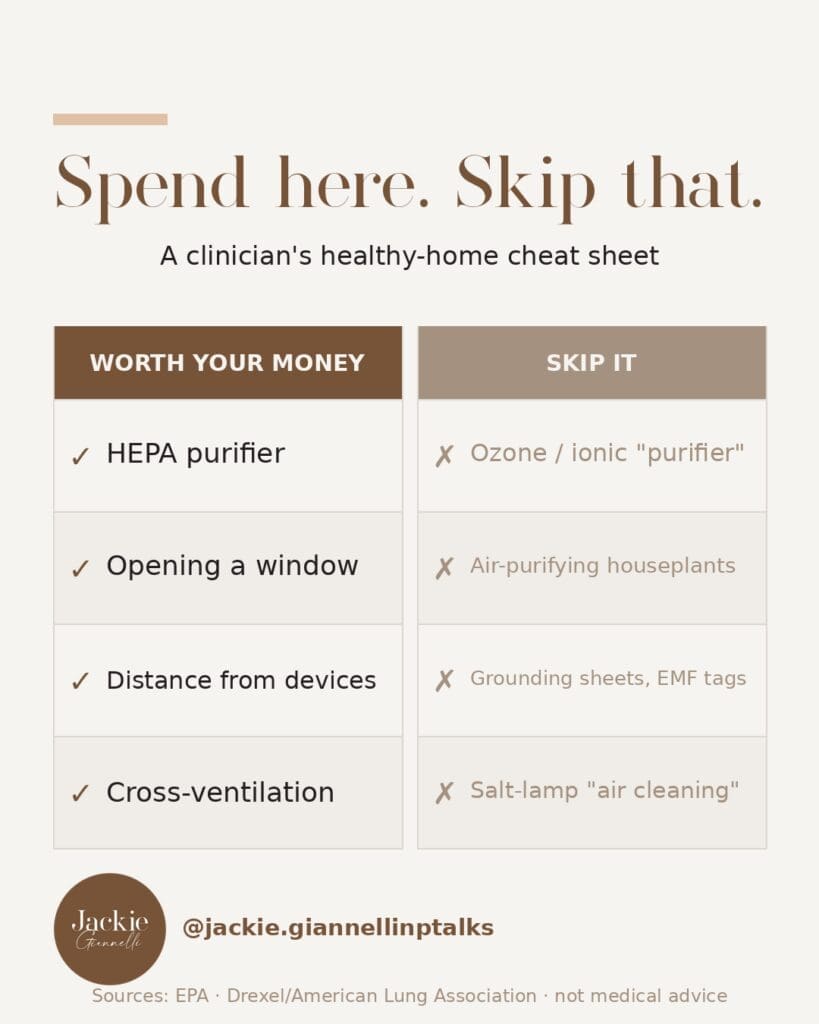
Air. The cheapest intervention in this entire post is free: open your windows. Cross-ventilation clears accumulated indoor air better than most gadgets. A HEPA air purifier sized to the room is the evidence-backed pick.
The one-swap-per-room non-toxic home method
If you want a single, unignorable place to begin, here’s the order I’d give you in clinic. One per room, done over a month, and you’ve meaningfully lowered your load without gutting anything.
- Kitchen: retire your most-worn nonstick pan; stop heating food in plastic.
- Bedroom: switch to fragrance-free laundry detergent, ditch dryer sheets.
- Bathroom: replace your most-used leave-on product (lotion or body wash) with a fragrance-free version.
- Living room: open windows daily; damp-dust and HEPA-vacuum.
- Whole home: as anything wears out (pans, containers, mattress, furniture), replace it with the lower-tox version instead of the default.
>> No more mistaking a shopping spree for actual health, ok?
What to skip (or at least stop stressing about)
Some of the loudest “detox” advice online is a waste of your money and worry.
Here are the ones that land on my skip list (this is by no means a comprehensive list of scammy home wellness items):
- Ozone-generating “air purifiers” and ionizers. The EPA is blunt about these. At safe levels they don’t effectively clean the air, and the ozone they emit is a lung irritant that can trigger coughing, chest tightness, and worse asthma symptoms. No ozone generator is approved for use in an occupied room. (7) A purifier that pollutes is not a purifier. (Real HEPA units are a different story. Those work.)
- Himalayan salt lamps make a lovely nightlight. They do not clean your air, release any meaningful “negative ions,” or do a thing for your hormones.
- Air-purifying houseplants are the myth I almost hate to break, because I love a plant. But a review spanning 30 years of data found ordinary ventilation clears indoor pollutants far faster than plants can. You’d need something like a hundred plants per square meter to match opening a window. (8) Keep the pothos because it makes you happy, not because it’s filtering anything.
- “Electrical environment” gadgets: grounding sheets, EMF stickers, harmonizer pendants. These are all marketed to play on your fear. Don’t believe the “hype.”
When having a “non-toxic home” is the wrong worry
The short answer: a low-tox home is a reasonable, evidence-informed goal, but it is not a substitute for medical care.
I hope this goes without saying, but if you’re dealing with persistent symptoms, new or worsening, don’t let a home-detox project delay a real work-up. Home environment is one lever among many. If you have a specific concern like known mold exposure, a gas leak, or symptoms that started with a move or renovation, that’s a “call a professional” situation, not a “buy a different candle” one. Reducing your household load is worth doing. It’s just not the whole story. A non-toxic home isn’t really the goal, a lower burden one is.
FAQ
Start with the non-toxic home swaps that cost nothing or almost nothing: open windows daily, switch to vinegar and baking soda for cleaning, stop heating food in plastic, and choose fragrance-free versions of products you already buy. The cheapest changes are often the highest-impact ones. (4)
The kitchen, because it’s where chemicals, heat, and food intersect. Retiring worn nonstick cookware and stopping the habit of microwaving food in plastic are the two highest-leverage kitchen changes. (3)
Work in order of impact, not all at once. The way to reduce toxins in your home without a big spend is one swap per room, made as products run out: start with what touches you daily (food storage, laundry, skincare), ventilate, and let the rest age out. You lower the load steadily without a single large purchase.
They can be. The EPA has found common organic pollutants running two to five times higher indoors than outdoors, largely from building materials, furniture, cleaners, and fragrance. (2) The most effective and cheapest fix is ventilation: open windows and move air through the house.
No. Your liver and kidneys handle detoxification; supplements and foot pads marketed for “toxin removal” are not supported by evidence. (9) Your money is better spent on reducing exposure in the first place.
Usually, yes, because the two words mean different things. “Unscented” often still contains fragrance chemicals, added to mask or neutralize the product’s own smell, and “fragrance” on a label can legally hide undisclosed ingredients like phthalates. “Fragrance-free” means no fragrance was added at all, which is why it’s the more reliable term to look for.
Many household chemicals are classified as endocrine disruptors, meaning they can interfere with normal hormone signaling. (1) No single product is likely to be decisive, but reducing your cumulative exposure is a sensible lever, especially in perimenopause when your hormones are already shifting.
This article is for informational and educational purposes only and is not medical advice. Always consult your healthcare provider about your individual situation.
References
- Endocrine Society / NIEHS. Endocrine-Disrupting Chemicals (EDCs) overview. https://www.niehs.nih.gov/health/topics/agents/endocrine
- U.S. EPA. The Inside Story: A Guide to Indoor Air Quality. https://www.epa.gov/indoor-air-quality-iaq/inside-story-guide-indoor-air-quality
- Migration of Antimony and Phthalate Esters from Plastic Food Packaging: A Systematic Review. Current Research in Nutrition and Food Science, 2025. https://www.foodandnutritionjournal.org/volume13number3/migration-of-antimony-and-phthalate-esters-from-plastic-food-packaging-a-systematic-review-of-reported-levels-food-matrix-effects-and-influencing-factors/
- U.S. EPA. Safer Choice program. https://www.epa.gov/saferchoice
- ATSDR. ToxFAQs: Uranium https://wwwn.cdc.gov/TSP/ToxFAQs/ToxFAQsDetails.aspx?faqid=439&toxid=77 · Context: U.S. EPA, Private Drinking Water Wells, https://www.epa.gov/privatewells
- Reducing flame-retardant exposure through cleaning: behavioral intervention study. https://pmc.ncbi.nlm.nih.gov/articles/PMC6460909/ · Context: NIEHS/EHP “Dust, Unsettled,” https://pmc.ncbi.nlm.nih.gov/articles/PMC5269654/
- U.S. EPA. Ozone Generators That Are Sold as Air Cleaners. https://www.epa.gov/indoor-air-quality-iaq/ozone-generators-are-sold-air-cleaners
- Cummings BE, Waring MS. Potted plants do not improve indoor air quality. J. Exposure Science & Environmental Epidemiology (Drexel), 2019. Summary: American Lung Association, https://www.lung.org/blog/houseplants-dont-clean-air
- NCCIH. “Detoxes” and “Cleanses”: What You Need To Know. https://www.nccih.nih.gov/health/detoxes-and-cleanses-what-you-need-to-know


