


Medically reviewed by Jackie Giannelli, FNP-BC, MSCP
Dinner is ready. Everyone sits, and three phones land face-down next to the forks. Big deal or just a part of life? Phones at the dinner table feel harmless when no one is touching them. But the research on stress, sleep, and appetite in midlife points the other way. So, how do you convince your family (and tech-dependent teens!) to just leave the phone and fully engage?
It is possible, and it matters. Here’s why.
The phone-free table is just one aspect of how your home can work for or against your longevity. For the rest of the non-negotiables, grab my free Healthy Home Protocols guide. It covers the kitchen, bathroom, bedroom, laundry, air and water.
Are phones at the dinner table really that bad?
Phones at the dinner table cost you something even when you barely use them. In a 2018 field experiment from the University of British Columbia, researchers Ryan Dwyer and Elizabeth Dunn sent about 300 people out to eat with friends or family. Half kept their phones on the table. Half put them away. (1)
The diners with phones out used them for only about 11% of the meal. They still felt more distracted and enjoyed the meal less, by about half a point on a seven-point scale. (1) That’s a modest drop. But in a world where screens get so much of our attention, does it make sense to check out during social time?
The most useful detail in that study, to me, is that the cost showed up while the phone mostly just sat there. So it interrupted the meal, the connection, and the oxytocin you get when you spend time with others, even when it wasn’t necessarily in the diner’s hand.
What’s more, a 2016 University of Michigan survey led by Carol Moser asked 1,163 people, aged 8 to 88, how they felt about phones at meals. The strongest predictor of whether someone thought it was fine was how often they used their own phone at the table. (2) So if your first thought is “mine isn’t a problem,” that’s worth sitting with for a minute.
Why does eating dinner together matter for your health in midlife?
Eating dinner together matters because it’s the one gathering most households already have every day, and connection registers in your body as physiology. Your stress response, your sleep, and your appetite all respond to who is at the table and whether they’re present.
The big-picture research is consistent. A 2010 meta-analysis of 148 studies by Julianne Holt-Lunstad found that people with stronger social relationships had about 50% higher odds of survival over the years. (3)
Here’s why connection is important for you in your 40s and 50s, while your hormones are shifting: cortisol, your stress hormone, tends to rise in midlife. And oxytocin opposes it. Oxytocin gets produced when you connect socially with others.
And the dinner table is the easiest place to get it because it’s already on your calendar. In a 2022 Wakefield Research survey for the American Heart Association, 84% of U.S. adults said they wished they shared meals with loved ones more often. (4) The want is there, and so is the meal. It’s usually the phones that get in the way.
Your stress response at the table
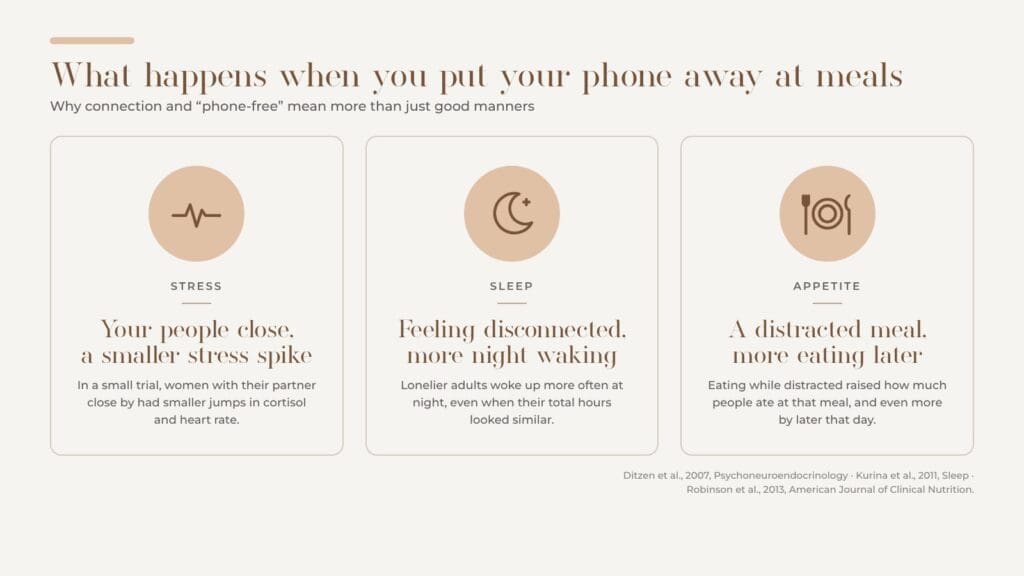
Having the people you trust physically close changes how your body handles stress. In a 2007 randomized trial published in Psychoneuroendocrinology, Beate Ditzen and colleagues gave 67 women ten minutes with their partner before a standardized stress test. The women who got physical contact from their partner, a neck and shoulder rub, had the smallest rise in cortisol and heart rate. The women who got only verbal encouragement did no better than the women who waited alone. (5) Sitting shoulder to shoulder and passing plates and sharing details about your day is the everyday version of that.
That’s one small trial, in women in their 20s and 30s, so take it loosely. But it does match what I see in practice.
Perimenopause tends to land in the busiest decade of your life, which is exactly when the evening needs to be the part of the day your body relaxes. I covered the light and noise side of this equation in my fall nervous system reset. The phone-free table is the connection side.
Your sleep after dinner
Feeling disconnected can show up in how you sleep, too. In a 2011 study in the journal Sleep, Lianne Kurina and colleagues at the University of Chicago measured sleep in 95 adults from a close-knit rural community.
The people who felt lonelier had more fragmented sleep, meaning more wake-ups during the night, even though their total sleep time looked about the same. (6)
Broken sleep is already one of the most common complaints I hear in perimenopause. I don’t want to overstate a 95-person study. But I do think it’s worth knowing that feeling unconnected and waking up at night can travel together.
For help setting up the perfect environment for sleep: read perimenopause sleep and your bedroom.
Your appetite with a phone in your hand
Eating while distracted tends to mean eating more, and not only at that particular meal.
What’s wild is in a 2013 meta-analysis in The American Journal of Clinical Nutrition, led by Eric Robinson, 24 studies were pooled. Distraction during a meal moderately raised how much people ate right then. And it also raised how much they ate later in the day even more. (7)
The likely reason is memory. If you barely registered dinner, your brain keeps a weaker record of it by the time you’re standing in the pantry at 9 p.m.
That matters more in midlife. The Study of Women’s Health Across the Nation, a long-running American project that has followed thousands of women through menopause, found that fat mass starts climbing and lean mass starts falling about two years before the final period. (8) So now’s the time to focus on doing the little things. The habits that support you instead of work against you.
Can loneliness make perimenopause brain fog worse?
Loneliness and perimenopause brain fog appear to be linked. In a study published in March 2026 in Menopause, the journal of The Menopause Society, researchers at Shandong University surveyed 903 perimenopausal women aged 45 to 55. Each step up the loneliness scale came with about 12% higher odds of reporting that their thinking had slipped, after accounting for age, education, menopausal symptoms, and major life events. The women who were both lonely and socially isolated had the highest odds of all. (9)
This was a survey taken at one point in time, and the memory slips were self-reported, so it can’t tell us which came first. It does tell me loneliness belongs on the list when you tell me your brain feels slower than it used to.
My take: in midlife, friendships tend to get crowded out by full calendars. Making a close friend takes real time together. Communication researcher Jeffrey Hall estimated that connection is forged at more than 200 hours. (10)
How to keep phones off the dinner table without a family fight
Keeping phones off the dinner table works best as a house setup you decide once, rather than a negotiation you have every night.
Step 1: Give the phones a home that isn’t the table
A basket on the counter or a charging drawer in the next room both work. If out of sight still isn’t far enough, a phone blocker like Brick locks the apps you choose until you tap the phone back on a small device that stays put. A drawer does the same job for free. What matters is the distance away from the table.
Step 2: Set an example
In Carol Moser’s Michigan survey, people judged adults’ phone use at meals more harshly when a child was at the table. (2) Kids notice who the rule applies to. Put yours away before you ask anyone else to.
Step 3: Start with one meal a week
Pick the dinner you’re most likely to have everyone home for and protect that one. A habit you keep for six months does more than a rule you drop in week two.
Step 4: Give the table something to do
A question jar, a deck of cards that lives on the sideboard, a dessert that takes a while to finish. A quiet lull is usually what sends people back to their phones.
Step 5: Set one extra place
Once a week or once a month, invite someone who doesn’t live with you. This is the step closest to the loneliness research above, and it’s the easiest one to put off.
The phone-free room we’re planning at the new house
Society is the sixth pillar in my 6S healthy home framework, and it’s the one I’m building around at our new place. My husband and I are planning to turn one room into a phone-free game and bar room for family and friends. I call my husband the CFO of our household: the Chief Fun Officer, and he’s so good at this.
Follow along on Instagram, and I’ll show you as it comes together.
Setting this up right is the habit. When a room is built for people, you don’t have to rely on willpower every night.
Frequently asked questions
At most tables, a little, yes. In the University of British Columbia dinner study, phones on the table were used for only about 11% of the meal and still lowered how much people enjoyed eating together. (1) Put yours away before you sit down, and the question never comes up.
There isn’t a proven number for adults. I’d rather you protect one phone-free dinner a week that happens than aim for seven and give up by Thursday. Build from there once the first one sticks.
It can. A 2013 meta-analysis of 24 studies in The American Journal of Clinical Nutrition found distraction during a meal raised how much people ate at that meal, and raised how much they ate later even more. (7) Your brain keeps a weaker record of a meal you didn’t pay attention to.
Eating alone isn’t a problem by itself. Plenty of your meals will be solo, and they still deserve your attention: phone away, food on a real plate, and taste it. The research flags loneliness, the feeling of being disconnected, more than the headcount at your table. (6, 9)
Decide where the phones live before dinner starts, put yours there first, and start with one meal a week. A basket on the counter works better than a speech at the table, because the decision is already made by the time anyone sits down.
Start with a standing invitation you can repeat, like the same dinner with the same two or three people once a month. Jeffrey Hall’s research estimated a close friendship takes more than 200 hours together, so repeated time with the same people matters more than a full social calendar. (10)
Start with the checklist
If you want to work through the rest of your house the same way we did here, one change at a time, download my free Healthy Home Protocols guide, a room-by-room checklist built for midlife hormones.
Then pick a night this week, put the phones in the basket, and see who stays at the table a little longer.
This article is for informational and educational purposes only and is not a substitute for medical advice, diagnosis, or treatment. Talk with your own clinician about your health.
References
- Dwyer RJ, Kushlev K, Dunn EW. Smartphone use undermines enjoyment of face-to-face social interactions. Journal of Experimental Social Psychology. 2018;78:233–239. https://www.sciencedirect.com/science/article/abs/pii/S0022103117301737
- Moser C, Schoenebeck SY, Reinecke K. Technology at the Table: Attitudes about Mobile Phone Use at Mealtimes. Proceedings of CHI 2016. n = 1,163, ages 8–88. https://news.umich.edu/phones-at-the-dinner-table-u-m-study-explores-attitudes/
- Holt-Lunstad J, Smith TB, Layton JB. Social relationships and mortality risk: a meta-analytic review. PLoS Medicine. 2010;7(7):e1000316. https://pubmed.ncbi.nlm.nih.gov/20668659/
- American Heart Association Healthy for Good / Wakefield Research. Survey of 1,000 U.S. adults, fall 2022. Reported Oct 11, 2022: https://newsroom.heart.org/news/new-survey-91-of-parents-say-their-family-is-less-stressed-when-they-eat-together
- Ditzen B, Neumann ID, Bodenmann G, et al. Effects of different kinds of couple interaction on cortisol and heart rate responses to stress in women. Psychoneuroendocrinology. 2007;32(5):565–574. https://pubmed.ncbi.nlm.nih.gov/17499441/
- Kurina LM, Knutson KL, Hawkley LC, Cacioppo JT, Lauderdale DS, Ober C. Loneliness is associated with sleep fragmentation in a communal society. Sleep. 2011;34(11):1519–1526. doi:10.5665/sleep.1390. https://pmc.ncbi.nlm.nih.gov/articles/PMC3198207/
- Robinson E, Aveyard P, Daley A, et al. Eating attentively: a systematic review and meta-analysis of the effect of food intake memory and awareness on eating. American Journal of Clinical Nutrition. 2013;97(4):728–742. https://pmc.ncbi.nlm.nih.gov/articles/PMC3607652/
- Greendale GA, Sternfeld B, Huang M, et al. Changes in body composition and weight during the menopause transition. JCI Insight. 2019;4(5):e124865. An analysis of data from the Study of Women’s Health Across the Nation (SWAN). https://pmc.ncbi.nlm.nih.gov/articles/PMC6483504/
- Lin X, Zhao X, Liu X, Zhao D, Guo J, Li P. Independent and joint associations of loneliness and social isolation with subjective cognitive decline in perimenopausal women. Menopause. 2026;33(9). Published online March 2026. https://doi.org/10.1097/GME.0000000000002763
- Hall JA. How many hours does it take to make a friend? Journal of Social and Personal Relationships. 2019;36(4):1278–1296. Hour figures confirmed via KU: https://journals.sagepub.com/doi/full/10.1177/0265407518761225


