


Medically reviewed by Jackie Giannelli, FNP-BC, MSCP
Your head is pounding. Your eyes itch, your nose is stuffy, and by the end of a work-from-home day you can’t finish a thought. Then you run out for groceries, and twenty minutes later your head is clear. If you’ve started asking “is my home making me sick?” then that pattern is worth taking seriously.
“Is my home making me sick?” is also a very midlife question. Peri can make you feel like your brain is full of peanut butter and give you itchy, puffy eyes, a runny nose, and even dermatitis.
So which is it, your hormones or your house? Often it’s both: shifting hormones lower your threshold, and the house supplies the trigger. Below, I’ll walk you through how to tell the difference and what to do about it, starting with the one check that can’t wait.
FREE: Grab my Healthy Home Protocols guide, a room-by-room checklist for making simple swaps that help decrease your exposure inside the house.
Can a house make you sick?
Yes, a house can make you feel sick, and the U.S. Environmental Protection Agency (EPA) has a name for the pattern: sick building syndrome. The EPA describes it as symptoms that seem linked to time spent in a building, with no single illness or cause to point to, and notes that “most of the complainants report relief soon after leaving the building.” (1)
What’s interesting is the fact that the EPA’s symptom list for sick building syndrome reads like a regular Tuesday when you’re in the midst of a midlife hormonal transition: headache, eye, nose or throat irritation, dry cough, dry or itchy skin, dizziness, nausea, difficulty concentrating, fatigue, and sensitivity to odors. (1)
Why is my house making me sick?
Some of the main reasons your house can make you feel less than your best:
- Too little fresh air
- Chemicals released from things inside
- Combustion from gas appliances, woodstoves, and fireplaces
When fall chill sets in, air tends to stop moving in your house, and combustion sources tend to increase. In summer, you run fans, open doors, and leave windows cracked. In autumn, you seal up, turn the heat on, and breathe the same air for hours.
This change in indoor air quality can lead to a whole host of symptoms, even cognitive ones.
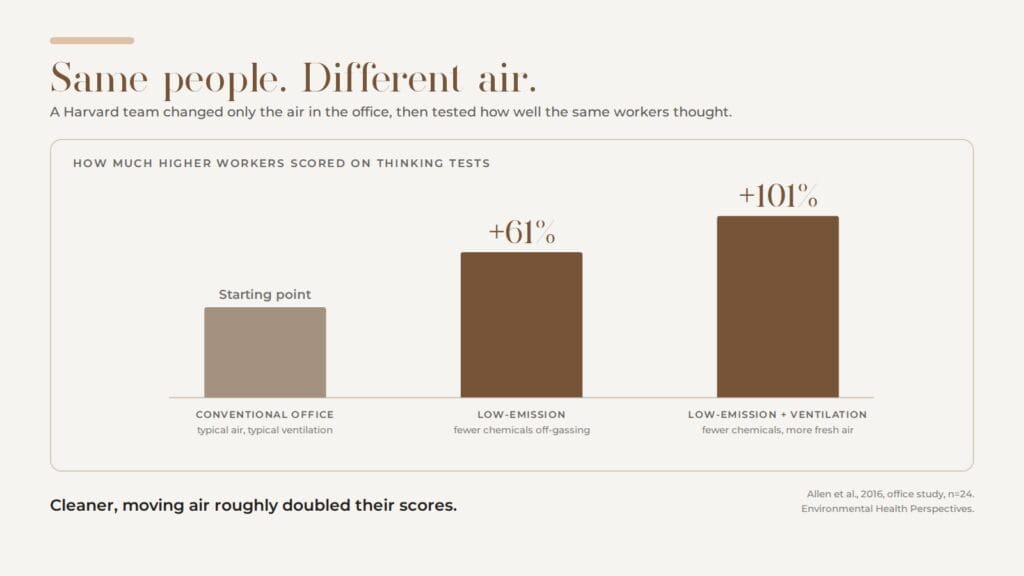
A Harvard team led by Joseph Allen actually tested this in a 2016 controlled study in Environmental Health Perspectives.
Twenty-four office workers spent six full workdays in rooms where the researchers changed only the air.
On days with low chemical emissions, cognitive scores were 61% higher than in the conventional setup. On days that added extra ventilation, scores were 101% higher. (2)
Carbon dioxide (the gas you exhale) and volatile organic compounds, or VOCs (the chemicals that off-gas from furniture, cleaners, and fragrance), were each linked to lower scores on their own.
That study was done in offices, not homes, and it measured decision-making, not how you “feel.” But it matches what I hear from patients every fall. Brain fog is real, and it tends to follow the closed windows. So if your kitchen table feels harder to think at in November than it did in July, this may be a clue.
Why midlife can make you notice it first
Perimenopause can lower your tolerance for a stuffy, scented house, so you may notice it first.
The National Headache Foundation notes that migraine attacks often get worse in peri in frequency, length, and intensity. (3)
While fluctuating hormones during this time are certainly tied to headaches and migraines, fragrance is one of the most common external triggers people report. In a survey of 1,136 U.S. adults, Anne Steinemann of the University of Melbourne found that 34.7% reported health problems from fragranced products, from breathing trouble to migraine headaches. (4)
Histamine may be part of the picture too. Mast cells, the immune cells that release histamine, carry estrogen receptors, and research suggests estrogen can make them quicker to react. (10) When estrogen is swinging in peri, that may help explain why the dust, mold, and fragrance you used to shrug off now leave you with itchy eyes, a runny nose, or itchy skin.
For women I see with MCAS (mast cell activation syndrome), where mast cells overreact, scent and indoor air can change how the whole day goes.
Add the fragmented sleep of peri, and your system has less slack for headache and allergy triggers.
So what does this mean for you? Two things.
First, you may feel changes in your house before your housemates do, and that doesn’t mean you’re imagining it.
Second, peri gives your symptoms more than one possible driver, which is why the next section starts with a quick triage.
Is my home making me sick? The four-step triage
When a patient asks me “is my home making me sick?” I work through the house in the same order I’d work through a symptom: most dangerous first, cheapest fix second, and nothing gets bought until the free steps are done.
Here’s where I’d start.
Step 1: Rule out carbon monoxide today
Start with carbon monoxide (CO), because it’s the one that can’t wait. The Centers for Disease Control and Prevention (CDC) lists headache, dizziness, weakness, upset stomach, vomiting, chest pain, and confusion as the most common symptoms, and describes them as easy to mistake for the flu. (5) More than 400 people in the U.S. die each year from unintentional CO poisoning unrelated to fires. (5)
The CDC’s advice is simple: a battery-operated or battery-backed CO detector near sleeping areas, new batteries twice a year, and an annual service for your furnace, water heater, and any gas appliance. (5) If more than one person (or your dog) feels ill at home and better outside, leave and call for help before you do anything else on this list.
Step 2: Move the air
Fresh air is the cheapest intervention in the world. The easiest thing to do? Burp the house by opening two windows on opposite sides for five minutes a day, even in cold weather, and let stale air leave. This works the ventilation lever from the Harvard study above at zero cost. (2)
Step 3: Check the moisture
Mold needs water, so moisture is the next suspect. The EPA’s guidance is to keep indoor humidity below 60%, ideally between 30% and 50%. (6) Look for a musty smell, condensation on windows, a damp basement, or a bathroom that stays wet long after a shower.
The Centers for Disease Control and Prevention (CDC) says mold can cause a stuffy nose, sore throat, coughing or wheezing, burning eyes, or a skin rash in some people, and that people with asthma or mold allergies may have severe reactions. (9) If your symptoms look more like allergies than a headache, move moisture up your list of things to investigate.
Remember, heating season pulls humidity down, and very dry air brings with it itchy eyes and sinus misery.
Step 4: Find the sources
Once you’ve got the air moving and the moisture is managed, look at what’s putting things into the air: the gas stove, candles, plug-in air fresheners, scented laundry, and new furniture or paint.
There are often xenoestrogens hiding in fragrance, and almost every piece of furniture, rug, or textile in your home could potentially be off-gassing VOCs. One new thing on its own may not be disrupting your life, but brand new wall-to-wall carpet or a new mattress, sheets, and curtains all at once could be triggering your symptoms.
Obviously, you can’t stop cooking, and it’s often very costly to convert from gas to electric appliances. But it’s easy to open a window just a crack when you’re using the range.
Toss out the highly fragranced plug-ins and scented laundry detergent.
Is my home making me sick, or is it my hormones?
Now, it’s possible to blame your house for your symptoms, when really it’s your hormones…and vice versa.
So here’s what I’d recommend.
For 14 days, jot down three things when a symptom hits: where you were, what time it was, and where you are in your cycle if you still have one.
Then look for these patterns:
- Do you feel better within an hour of leaving the house, worse within an hour of coming home?
- Do you notice symptoms more on weekends or work-from-home days than on office days?
- Do other people in the house (or the dog) have similar complaints?
- Do things start or get worse when the heat comes on, or the windows are closed?
- Do symptoms seem to be inexplicable? Is it possible they are cyclical?
If the pattern follows the house, you have your answer and a place to start. Download my free Healthy Home Protocol checklist to get started.
If symptoms seem to follow your cycle, or they don’t seem to let up anywhere you go, take that pattern to your clinician. Symptoms that persist wherever you are deserve a proper workup.
Something in my house is making me sick: what to skip
When something in your house seems to be making you sick, the urge is to buy a bunch of gadgets and start throwing things out. Which, depending on your situation, may be the right move for you.
But here are two purchases I’d definitely skip.
Ozone “air purifiers.” The EPA is blunt about these: ozone can harm your health, and at levels that don’t exceed public health standards, it’s generally ineffective at cleaning indoor air. (7) If a device advertises “activated oxygen” or ozone, pass.
Mold test kits, if you can already see mold. The EPA’s position is that “in most cases, if visible mold growth is present, sampling is unnecessary.” (8) Spend that money on fixing the leak and cleaning up.
What I’d spend on instead:
A good quality carbon monoxide detector if you don’t already have one.
And then nothing until you’ve done two weeks of burping the house and keeping notes. The most this will cost you is a few minutes of time each day.
Frequently asked questions
The three most common culprits are too little fresh air, chemicals released from things inside the house (fragrance, cleaners, new furniture), and combustion from gas appliances. Moisture and mold are a close fourth. Rule out carbon monoxide first, then work through air, moisture, and other sources in that order.
Heating season is when you close the windows and ventilation drops, so carbon dioxide and chemical emissions build up indoors. Dry heated air can also irritate eyes, skin, and sinuses. If symptoms began when the windows closed, start with a daily five-minute cross-ventilation habit.
Yes. People react differently, and perimenopause can lower your tolerance for triggers like fragrance, stuffy air, and poor sleep. Your partner feeling fine doesn’t rule the house out as a trigger for your symptoms. A two-week symptom log will show whether your symptoms follow the house or your cycle.
The same triage applies to an apartment: carbon monoxide detector first, then fresh air, then humidity, then sources like fragrance and gas cooking. In a rental, report leaks and mold to your landlord in writing. You control more of the air in a small space than you might think, starting with opening windows.
Opening windows swaps stale indoor air for outdoor air, which lowers carbon dioxide and dilutes whatever is floating around inside. Five minutes of cross-ventilation with two windows on opposite sides of the house is enough to make a difference, even in cold weather. It won’t treat a virus or infection, but it can keep stuffy air from making you feel worse.
See a clinician if symptoms continue away from home, get worse over time, or include chest pain, confusion, or fainting. If several people or pets feel ill at the same time, leave the house and call for help, because that pattern can signal carbon monoxide.
Start with the checklist
If you’ve been asking “is my home making me sick?”, the fact that your head clears when you leave is the most useful piece of data you have. Now put it to work. My free Healthy Home Protocols guide walks you through each room and helps you choose what’s worth changing, what to skip, and how to do it without replacing everything you own.
Download it, open two windows, and start your notes tonight.
This article is for informational and educational purposes only and is not medical advice. Please talk with your own clinician about your specific symptoms.
References
- U.S. Environmental Protection Agency. Indoor Air Facts No. 4 (revised): Sick Building Syndrome. https://www.epa.gov/sites/default/files/2014-08/documents/sick_building_factsheet.pdf
- Allen JG, MacNaughton P, Satish U, Santanam S, Vallarino J, Spengler JD. Associations of Cognitive Function Scores with Carbon Dioxide, Ventilation, and Volatile Organic Compound Exposures in Office Workers: A Controlled Exposure Study of Green and Conventional Office Environments. Environmental Health Perspectives. 2016;124(6):805–812. https://pubmed.ncbi.nlm.nih.gov/26502459/
- National Headache Foundation. Menopause and Perimenopause. https://headaches.org/resources/menopause-and-perimenopause/
- Steinemann A. Fragranced consumer products: exposures and effects from emissions. Air Quality, Atmosphere & Health. 2016;9:861–866. https://link.springer.com/article/10.1007/s11869-016-0442-z
- Centers for Disease Control and Prevention. Carbon Monoxide Poisoning Basics. https://www.cdc.gov/carbon-monoxide/about/index.html
- U.S. Environmental Protection Agency. A Brief Guide to Mold, Moisture and Your Home. https://www.epa.gov/mold/brief-guide-mold-moisture-and-your-home
- U.S. Environmental Protection Agency. Ozone Generators that are Sold as Air Cleaners. https://www.epa.gov/indoor-air-quality-iaq/ozone-generators-are-sold-air-cleaners
- U.S. Environmental Protection Agency. Mold Testing or Sampling. https://www.epa.gov/mold/mold-testing-or-sampling
- Centers for Disease Control and Prevention. About Mold and Your Health. https://www.cdc.gov/mold-health/about/index.html
- Zierau O, Zenclussen AC, Jensen F. Role of female sex hormones, estradiol and progesterone, in mast cell behavior. Frontiers in Immunology. 2012;3:169. https://pubmed.ncbi.nlm.nih.gov/22723800/


