


Medically reviewed by Jackie Giannelli, FNP-BC, MSCP.
Search “healthy home” and you’ll mostly find warnings about mold, radon, and lead paint. And while those things matter, they don’t explain why you’re up at 3 am, foggy by noon, and desperately trying to find your keys. I’m a nurse practitioner who treats midlife women, and I’ve come to realize that there are sneakier factors at play inside your home’s biome that can seriously impact your quality of life and your health.
I read a home like I read a patient’s chart. I call my method the 6S framework: Sleep, Sweat, Sex, Satiety, Serenity, Society. Six systems that shift hard in perimenopause, and six things your house is either supporting or working against, every single day, whether or not you ever think about it.
Before you keep reading: all of my best stuff goes out to my newsletter list first. In the Saddle is where I send the actual swaps, the products I’d put in my own house, and the research behind them. It’s free, and I send it once a week.
What a healthy home actually means
Americans spend roughly 90 percent of their time indoors, and concentrations of some indoor pollutants run two to five times higher than typical outdoor levels. (2) So your house is the environment your physiology sits in all night, and on the weekends. You don’t have control over what the office uses for lighting or the perfume your coworker insists on overspraying, but you can control your home environment.
The wellness real estate industry has started catching up to this. There’s a field called neuroaesthetics studying how light, sound, texture, and space shape mood, cognition, and stress response, and a related idea called the “home biome,” which treats your air, water, light, and materials as one connected system. (3)
Beth McGroarty of the Global Wellness Institute put the shift plainly: “The first chapter of longevity was all about travel destinations … but it’s [evolved beyond that] because it doesn’t make sense for it to be a sporadic travel experience. If you’re really obsessed with longevity and healthspan, it has to come home.”
I agree, with one clinical amendment. Most of what gets built on that idea includes a full remodel or tear down of your entire house, which is great when you have the means and the time to do so. But also, most of us just want to start with small changes that don’t necessarily require a contractor, right?
So when I talk about a healthy home, I mean the house you already live in, adjusted in the places where the adjustment does the most physiological work.
I was planning on renovating my 1920’s farmhouse and decided to move instead. If you’re into home design, intentional living, and how it all impacts your health: be sure to follow along on Instagram, I’d love to hang out with you!
Your home’s biome and perimenopause
In your late 30s and 40s, estrogen and progesterone start fluctuating in ways they never did before. And estrogen is involved in thermoregulation, sleep architecture, cognition, bone, mood, and vascular function. When those signals get noisy, your margin shrinks. The stale bedroom, the overhead lights at 10 pm, the scented laundry, the fragmented sleep: your body absorbed all of that for free at 32. At 47 it doesn’t.
Which is why I organize this around your physiology instead of around your floor plan. Six systems, six rooms’ worth of decisions.
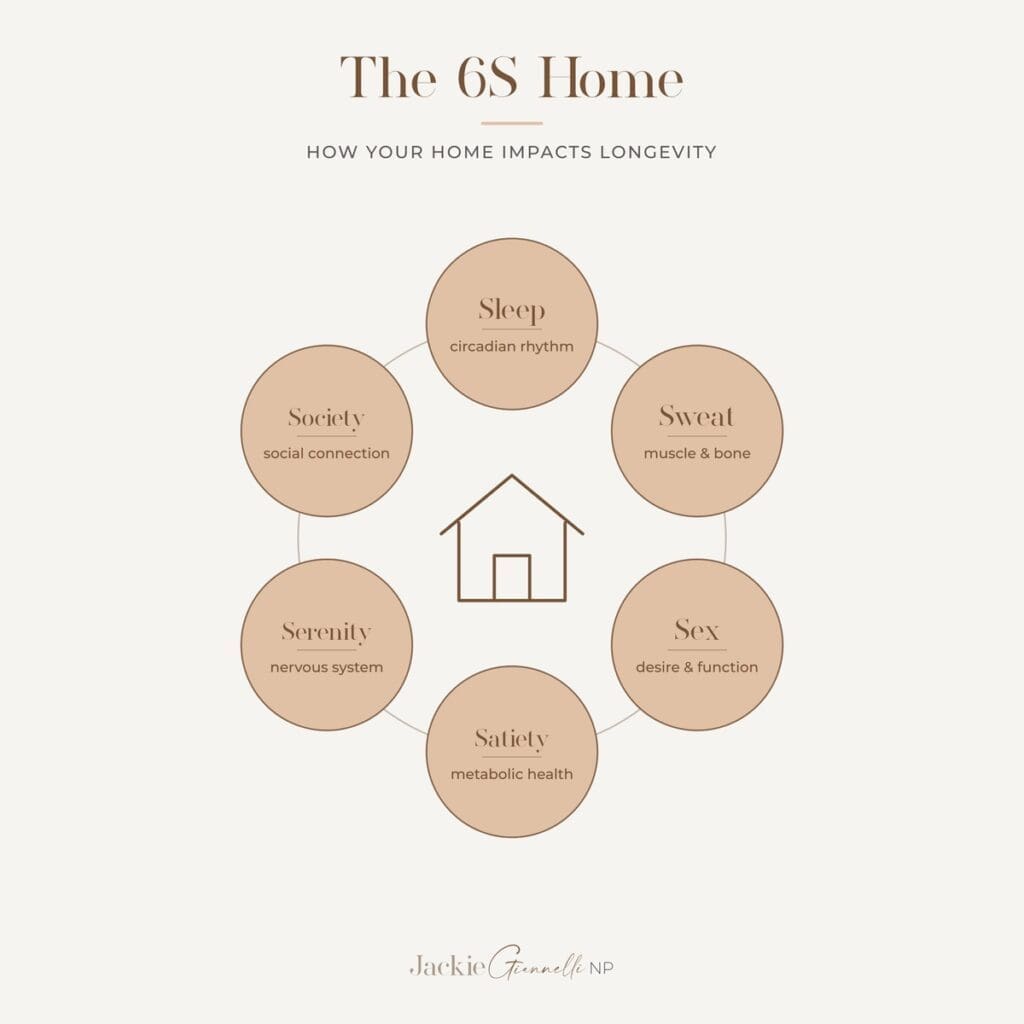
The 6S framework: a clinician’s healthy home, pillar by pillar
This is my proprietary clinical framework for a healthy home. I’ve only ever shared this with patients before!
Sleep
Perimenopausal sleep breaks in a specific way. Declining progesterone fragments sleep, and thermoregulation is already unstable, which is why the 3 am wake-up shows up years before anyone says the word menopause.
Your bedroom either fights that or compounds this situation. Ordinary room light in the hours before bed suppresses melatonin onset and shortens melatonin duration. (4) Read that again: your bright overhead kitchen light is doing measurable endocrine work at 10 pm.
The levers: warm, dimmable, low-mounted light after dinner. A cool room. Breathable natural-fiber bedding, since you’re in skin contact with it for seven hours. Fragrance-free laundry for the same reason. Screens out of the room, or at least out of arm’s reach. I wrote the long version of this in the bedroom rules for deep sleep.
When my patients get intentional about their bedroom environment, they typically see meaningful changes in how they feel. Sleep really is that important.
Sweat
Muscle and bone are the two assets midlife women are actively defending, and both respond to frequency more than intensity. The obstacle is rarely motivation. It’s friction.
The lever here is embarrassingly simple: put the equipment where you’ll trip over it.
Kettlebell in the kitchen. Mat unrolled, not rolled. Weights visible in the room you’re already standing in. A home that makes movement a decision every time will lose to a home that makes it the path of least resistance.
This is the pillar where “healthy home tips” usually go straight to a home gym build-out, and that isn’t the constraint for most women. Ten reachable minutes, four times a day, beats a beautiful basement gym you visit only on Sundays.
Sex
This is the pillar almost nobody covers credibly, and I’m going to, because sexual medicine is my clinical training.
Desire in midlife is biopsychosocial. Stress load, sleep debt, and an environment with zero intimacy cues all suppress it, and sleep is the piece with the clearest data: in a pilot study of women’s sexual response, longer sleep duration predicted greater next-day sexual desire. (5)
The levers are environmental. Lighting you can lower. A door that closes. Privacy that’s real. Devices out of the bedroom, because a phone on the nightstand is a third party in the room. If the only signal your bedroom sends is “work here, scroll here, collapse here,” your body will read that signal accurately.
Satiety
The 3 pm crash is usually three loads stacked: fragmented sleep, stuffy indoor air, and blood sugar swings. Only one of those gets treated as a food problem, but the kitchen is where all three converge.
Again, some of the simplest things here work the best.
Keep your protein at eye level, so you reach for it first. Make water easily accessible. Put that filter out so it’s where you stand while you’re talking on the phone. Put the snacks you actually want to eat prepped in a clear glass container in front of the fridge, not the back on the second shelf.
And keep heat away from plastic: heating food in plastic accelerates chemical migration into what you eat, and many bisphenols and phthalates act as estrogen mimics your endocrine system doesn’t need right now. (6) Glass for anything hot. The full version of that is in this article on endocrine disruptors in plastics.
Serenity
Estrogen has a real role in cognition, which means a midlife brain has less spare capacity for stacked co-factors. Visual clutter, noise, and stale air can all be translated as cognitive load at this stage of life.
Noise is another factor. WHO’s environmental noise guidelines flag nighttime noise as a driver of sleep disturbance and cardiovascular risk, not merely an annoyance. (7) So: soft surfaces to absorb sound, a bedroom on the quiet side of the house if you have the choice, one visually calm surface per room (not the whole room, one surface), and a ventilation habit. Open two windows on opposite sides of the house for five minutes a day and let the stale air leave.
Society
The U.S. Surgeon General’s advisory on loneliness laid out the mortality and cardiovascular risk associated with social disconnection in terms that are hard to look away from. (8)
Connection registers in the body the way sleep and movement do, and midlife is exactly when a woman’s social infrastructure can begin to thin out.
In your home, this can mean: building one room where the phone doesn’t come. A table people sit at. A game shelf, a bar cart, a fire pit, whatever gets your people into a room together without a screen mediating it. Make it easy to spend intentional time with the ones you love. That’s the key.
Your healthy home checklist: one room, one change
Here’s how I think about the 6S Framework.
Pick one thing you’re struggling with the most. And find the room that impacts it the most. Then make one change. Live with it for two weeks. Then do it again.
If you want a starting order, this is the one I use with patients:
- Bedroom > Sleep. Swap your evening lighting to warm and low. Kick the air down before bed.
- Kitchen > Satiety. Stop heating food in plastic. Change your three most-used containers to glass.
- Laundry > Sleep. Switch to fragrance-free detergent, especially for your sheets. You’re in contact with them all night.
- Back patio > Society. Make it phone-free and see who shows up for a card game.
This is what a healthy home looks like when a clinician builds it.
What a healthy home will not do
No lightbulb, no detergent, and no air purifier is going to give you back the hormonal stability of your thirties. Environmental load is one input among many, and it sits alongside sleep, strength training, nutrition, hormone therapy where it’s appropriate, and actual medical care.
What the house does is change your margin. It is the one variable in this whole picture that you control completely, that works every night whether or not you have the energy to think about it.
Want to learn more about hormones, the home biome, and how to thrive in midlife? I break down one 6S pillar at a time in In the Saddle, my FREE weekly newsletter, with the specific swaps, the products I’d put in my own house, and the research behind each one. I’ll see you in your inbox!
This post is for informational and educational purposes only and is not medical advice. It is not intended to diagnose, treat, cure, or prevent any disease. Talk to your own healthcare provider about your situation.
Frequently Asked Questions
A healthy home supports the systems your body depends on rather than adding load to them. The clinical version I use is the 6S framework: Sleep (light, temperature, bedding), Sweat (movement made frictionless), Sex (privacy and intimacy cues), Satiety (a kitchen that makes good defaults easy), Serenity (noise, clutter, and air), and Society (a screen-free room where people gather). And, we can’t forget about healthy housing standards that focus on hazards like mold, lead, and radon, which matter too.
The bedroom, and specifically your evening lighting. Ordinary room light before bed suppresses melatonin onset and shortens melatonin duration, so switching to warm, dimmable, low-mounted lamps after dinner is the cheapest change with the clearest evidence behind it. Then move to the kitchen and stop heating food in plastic.
It contributes. Americans spend about 90 percent of their time indoors, and some indoor pollutant concentrations run two to five times outdoor levels. Many bisphenols and phthalates act as estrogen mimics, and heat accelerates their migration from plastic into food. That added load matters more in perimenopause, when your own hormone signaling is already fluctuating. Your home is not the cause of perimenopause, and lowering the load is still one of the few inputs entirely within your reach.
Use the one-room, one-change method instead of a master list. Pick a room, identify which 6S pillar it serves, make a single change, and live with it for two weeks before the next one. My suggested order: evening lighting, then plastic out of the microwave, then fragrance-free laundry, then a daily five-minute cross-ventilation habit, then one phone-free room.
Sleep, Sweat, Sex, Satiety, Serenity, and Society. Each one maps to a physiological system that shifts in midlife and to specific levers in the home that either support that system or add load to it.
No, and I’d actively discourage it. Attrition works better than a purge: replace things as they wear out, prioritize whatever touches heat, food, or your skin overnight, and let the rest age out. The daily, heated, skin-contact exposures are where the meaningful load lives.
References
- National Center for Healthy Housing. “The Principles of a Healthy Home.” nchh.org
- U.S. Environmental Protection Agency. “Indoor Air Quality,” Report on the Environment. epa.gov
- Global Wellness Summit. “Neuroaesthetics Is Reshaping Wellness and the Built Environment.” globalwellnesssummit.com
- Gooley, J.J., et al. (2011). “Exposure to Room Light before Bedtime Suppresses Melatonin Onset and Shortens Melatonin Duration in Humans.” Journal of Clinical Endocrinology & Metabolism, 96(3), E463–E472. pubmed.ncbi.nlm.nih.gov
- Kalmbach, D.A., et al. (2015). “The Impact of Sleep on Female Sexual Response and Behavior: A Pilot Study.” The Journal of Sexual Medicine, 12(5), 1221–1232. onlinelibrary.wiley.com
- Endocrine Society. “Plastics, EDCs & Health.” endocrine.org
- World Health Organization Regional Office for Europe. Environmental Noise Guidelines for the European Region (2018). who.int
- Office of the U.S. Surgeon General. Our Epidemic of Loneliness and Isolation (2023). ncbi.nlm.nih.gov


